Book a standard visitor visa UK appointment at VFS Global
- You've filled out the Standard Visitor Visa application on GOV.UK, paid the fee, answered every question honestly — and then the website tells you to book an appointment at a Visa Application Centre.
- You weren't expecting that.
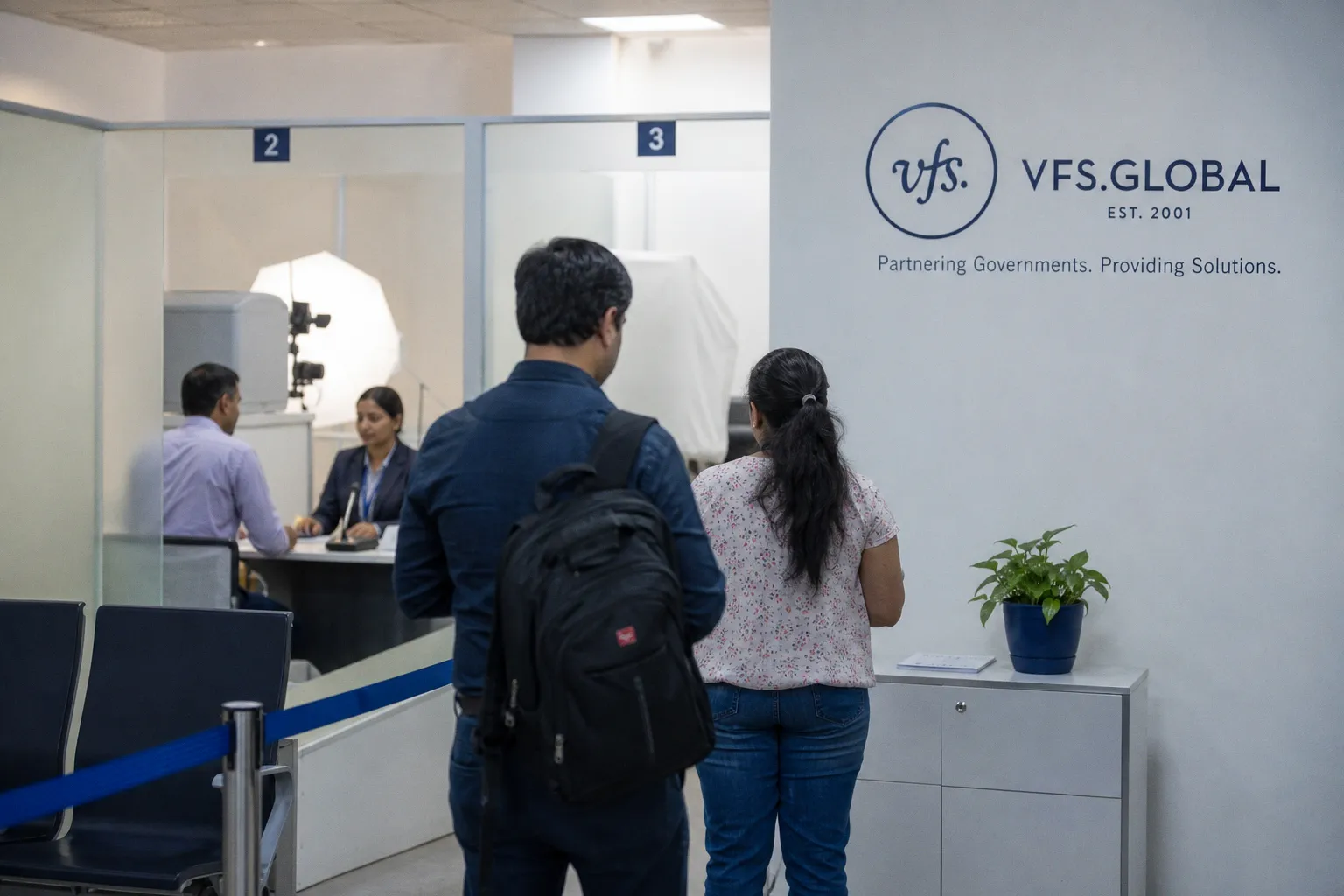
From GOV.UK to the Visa Application Centre: What Actually Happens Next
Here's the first thing to understand: submitting your Standard Visitor Visa application online does not mean your application is complete. GOV.UK collects your answers, your supporting documents (uploaded digitally), and your payment — that's the visa fee and, where applicable, the Immigration Health Surcharge. Only after all of that is settled does the system redirect you to book a biometric appointment.
You cannot skip this. Every single applicant, regardless of nationality, age, or travel history, must attend a Visa Application Centre in person to provide biometric information — fingerprints and a photograph. The UK government doesn't process Standard Visitor Visas without it.
The commercial partners that run these centres are VFS Global and TLScontact. Which one you use depends entirely on the country where you're applying. GOV.UK will direct you to the correct provider at the end of your application flow. You do not get to choose between them; the routing is automatic.
You cannot book a biometric appointment through VFS Global or TLScontact directly. The appointment booking link only appears after you've completed and paid for your application on GOV.UK.
If you try to go straight to the VFS Global website and book a slot before finishing the GOV.UK process, you'll hit a dead end. The system won't recognise you. So the sequence is non-negotiable: GOV.UK application first, payment second, appointment booking third.
Inside the Visa Application Centre: What Biometric Enrollment Actually Involves
The phrase "biometric enrollment" sounds clinical, and if you've never done it before, it can trigger a certain amount of anxiety. Don't let it. The appointment itself is typically brief — often under fifteen minutes once you're called forward — and the staff at VFS Global and TLScontact centres handle these all day, every day.
Here's what happens when you arrive:
1. Document check at reception. You'll present your passport and appointment confirmation. Some centres also ask to see a printed copy of your application summary, though many now work from the digital record. Bring a printout anyway — it costs nothing and removes one variable from the day.
2. Biometric capture. A staff member scans your fingerprints electronically and takes a digital photograph. No ink, no paper. The photo must meet standard requirements — no glasses, no head coverings (unless for religious reasons), neutral expression, looking straight at the camera. If you've had a UK visa before, your old biometrics are overwritten by the new set.
3. Document submission (if required). Depending on your application type and location, you may be asked to hand over supporting documents at this stage, or you may have already uploaded everything digitally during the online application. The GOV.UK system will clarify which applies to your case. If in doubt, bring originals and copies of everything you submitted.
4. Optional premium services. At this point, the centre may offer you additional paid services — document scanning assistance, SMS updates on your application status, or a premium lounge experience. These are entirely optional. They do not influence the decision on your visa. They're convenience add-ons sold by the commercial operator, not the Home Office.
If you're applying from a country where VFS Global is the provider, you might also encounter the option to keep your passport during processing — useful if you have other travel planned while your Standard Visitor Visa application is being assessed. TLScontact offers a similar service in some locations. Availability and pricing vary, so check what's on offer when you book.
The biometric appointment is a procedural step, not an interview. You're not being assessed on your answers — those are already in your application. The centre is simply collecting your physical identifiers.
The Three-Week Wait: Managing the Standard Processing Timeline
Once you've attended your biometric appointment, the clock starts. The standard processing time for a UK Standard Visitor Visa decision is three weeks — that's fifteen working days from the date of your appointment, not from the date you submitted the online application.
Three weeks sounds manageable until you factor in the reality that processing times fluctuate with seasonal demand. Summer months, major holiday periods, and the weeks leading up to the Chinese New Year all see spikes in application volumes. The Home Office processes applications in the order they're received, and capacity isn't infinite. If your travel date is tight, three weeks can feel like a knife edge.
Here's what "three weeks" means in practice:
| Scenario | What to expect |
|---|---|
| You applied well in advance (6+ weeks before travel) | Standard processing is almost certainly fine. Sit tight. |
| You applied 4–5 weeks before travel | Standard processing should work, but keep an eye on the timeline. No action needed yet. |
| You applied 3 weeks or less before travel | Consider whether Priority or Super Priority processing is available at your location and worth the cost. |
| You applied less than 2 weeks before travel | You're in difficult territory. Premium services may still rescue the timeline, but availability is not guaranteed. |
The important thing to remember is that you cannot expedite a standard application after the fact. If you've already submitted on the standard track and your travel date is approaching, your only option is to hope for a faster-than-average turnaround — which does happen, but you shouldn't bank on it.
Planning ahead matters enormously here. If you know you'll need a Standard Visitor Visa — for a family visit, a short business trip, or a holiday — build the application into your travel planning from the start, not as an afterthought. Just as you'd plan a relocation with care, giving yourself buffer time for the visa process removes a layer of stress that nobody needs.
Priority and Super Priority: Faster Processing at a Premium
If three weeks is too long, VFS Global and TLScontact offer expedited processing tiers at select locations. These are not available everywhere, and the Home Office makes no guarantees about their continued availability at any given centre.
Priority service targets a decision within five working days of your biometric appointment. Super Priority service aims for the next working day. Both require an additional fee on top of the standard visa application charge, and pricing varies by region — it's denominated in local currency and set by the commercial operator.
A few critical realities to keep in mind:
- Not every VFS Global or TLScontact location offers Priority or Super Priority. Major centres in capital cities are more likely to have these options; smaller regional offices may not. You'll see what's available when you reach the appointment booking stage on the GOV.UK system.
- "Available" doesn't mean "available right now." Premium service slots fill up, especially during peak travel seasons. If you're counting on Super Priority to save a tight timeline, book the moment slots open.
- Paying for Priority does not change the quality of the assessment. Your application is evaluated against exactly the same criteria as every other Standard Visitor Visa application. Speed is the only thing you're buying — not a more lenient review, not a friendlier pair of eyes.
- The processing clock starts from your biometric appointment, not from when you pay the premium fee. If you pay for Priority but your appointment isn't for another week, that week eats into your timeline.
If you're unsure whether premium processing is right for your situation, weigh the cost of the service against the cost of missing your travel date. For a once-in-a-family-lifetime wedding or a business commitment with contractual implications, the fee may be entirely justified. For a flexible holiday, it might not be.
The Mistakes That Slow People Down
After watching hundreds of travellers navigate this process, certain patterns emerge. The problems that cause delays and frustration are almost always avoidable.
Waiting too long to start. This is the single most common issue. People assume the Standard Visitor Visa is a quick online form and are then blindsided by the biometric appointment requirement and the three-week processing window. If your trip is in six weeks, start today — not next weekend.
Booking the appointment at the wrong VAC. GOV.UK directs you to the correct VFS Global or TLScontact provider for your country. If you're applying from a country that isn't your nationality — say, you're a Nigerian national living in Turkey — make sure your application reflects where you actually are, because the system routes you accordingly.
Arriving at the VAC without the right documents. Even though much of the process is digital now, some centres still require physical copies of your appointment confirmation and passport. Bring everything. Over-preparing at this stage costs you a printer cartridge; under-preparing could cost you a wasted trip and a rebooked appointment.
Not checking appointment availability before committing to travel dates. This one stings. You book flights, then discover the next available biometric appointment is three weeks away, and now your entire timeline is blown. If possible, check what appointment slots look like before you finalise non-refundable bookings.
Ignoring the option to keep your passport. If you have other international travel planned during the processing window — a connecting flight, a short trip to a neighbouring country — paying for the passport retention service lets you continue moving while the Home Office assesses your application. It's not available at every centre, but where it is, it can be a lifeline.
Getting Through the Process Without the Stress
Here's the honest truth: the Standard Visitor Visa appointment process is bureaucratic, but it is not adversarial. VFS Global and TLScontact are service providers, not gatekeepers. They collect your biometrics and forward your application. The decision is made by the Home Office, not by the person scanning your fingers at the counter.
If you've submitted a complete and truthful application, attended your biometric appointment, and given yourself realistic processing time, the system works. It's not fast, and it's not cheap, but it's predictable — and predictability is worth a lot when you're planning international travel.
One practical tip for the day of your appointment: arrive early, but not too early. Most VFS Global and TLScontact centres operate on a timed appointment system, and showing up forty-five minutes ahead won't get you seen sooner — it'll just mean sitting in a waiting area with poor Wi-Fi. Ten to fifteen minutes early is the sweet spot. Bring your printed confirmation, your passport, a fully charged phone for the queue wait, and patience. You'll be through the biometric stage before you know it, and then the waiting — the real waiting — begins on the Home Office's clock, not yours.