Secure a Physical Passport Stamp at UK E-Gates for Visa Entry
UK Border Force requires a physical ink stamp in the passport of specific non-visa travelers to legally activate their right to work or study.
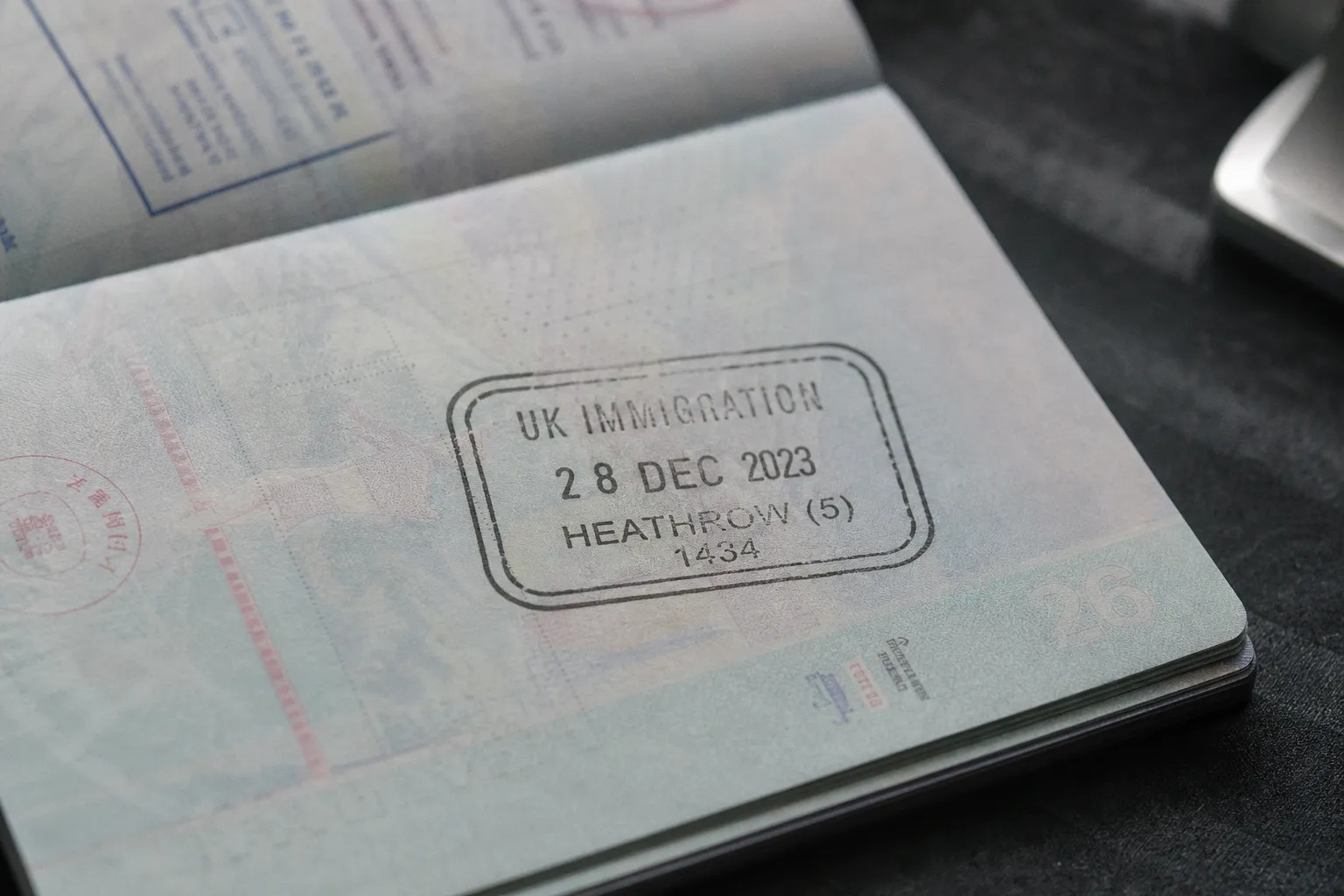
This is not a technicality. An e-gate reads the biometric chip and grants "leave to enter" as a standard visitor. The Home Office does not issue the entry stamp retrospectively. The traveler who bypasses the staffed lane when one is required cannot remedy the omission at a police station, a Home Office building, or a service desk inside the terminal. The only legal remedy is departure from the Common Travel Area (CTA) and re-entry through a staffed lane.
The Creative Worker Concession and the Necessity of Ink
The Creative Worker visa concession permits nationals of non-visa countries to enter the UK for short-term creative engagements of up to 3 months without a pre-applied visa. The route is widely used by performers, technicians, and crew entering for specific engagements under sponsor-led arrangements.
The condition is precise: the traveler must present themselves to a Border Force officer to receive a physical entry stamp. The stamp activates the concession. Without it, the e-gate system — and the Home Office record it generates — classifies the traveler as a standard visitor. Standard visitor leave prohibits most forms of paid work.
An e-gate does not validate a Creative Worker concession. The system reads the biometric chip and grants standard visitor leave. It does not know the traveler is here to perform.
The financial and contractual implications are immediate. An unpaid engagement becomes an immigration violation. A sponsor's compliance record is exposed to audit. The traveler may be required to cease the engagement, regularise their status, or depart. For a performer on a fixed-fee engagement, the cost of an immigration stop-work notice compounds with breach-of-contract exposure to the engager.
The concession itself operates on a narrow definition. It covers performers, artists, and their immediate technical and support crew. It does not extend to administrative staff, publicists, or management personnel unless they are integral to the creative output of the engagement. A tour manager arriving ahead of a four-date theatre run may qualify; a label representative arriving to negotiate streaming terms does not. The distinction matters because the wrong category of traveler using the concession — even with the stamp — creates a compliance breach that sits on the sponsor's record for the duration of their sponsor licence.
The sponsor's obligation is active, not passive. Under the concession framework, the sponsoring organisation must hold a valid Temporary Worker sponsor licence for the Creative Worker route. The sponsor must issue a Certificate of Sponsorship (CoS) before the traveler's arrival. The Border Force officer will expect to see evidence of this arrangement at the point of entry. Where the traveler has used an e-gate, there is no officer interaction, no stamp, and no moment at which the CoS is validated against the entry record. The Home Office compliance team — which conducts audits on sponsor licence holders — treats the absence of an entry stamp as evidence that the traveler entered under standard visitor conditions. The burden of proof then shifts to the sponsor to demonstrate otherwise, which they cannot do without the physical stamp.
For engagements that span multiple venues or regions — a touring musician covering dates in London, Manchester, Edinburgh, and Cardiff, for example — the practical challenge compounds. Each venue or promoter may require sight of the stamped passport page before confirming the engagement. Without it, the entire touring schedule is exposed to cancellation at short notice, and the financial liability cascades backward from the performer to the sponsoring organisation.
Short-Term Study Validation for Non-Visa Nationals
Non-visa nationals — including citizens of the USA, Canada, and Australia — entering for short-term study of up to 6 months must obtain a short-term student stamp to enroll at their institution. The same category of stamp is required where the traveler has not applied for a Student visa in advance.
The mechanism is identical to the Creative Worker concession. The e-gate issues standard visitor leave. The institution — a university, language school, or professional training provider — cannot enroll a student whose immigration status is recorded as visitor. The stamp is the legal instrument that permits enrollment.
A boarding pass is not a valid substitute for an entry stamp. The institution's compliance team will request the passport page, not the airline record.
University College London and other Russell Group institutions have published specific guidance directing non-visa national students to opt for the staffed lane. The instruction is operational, not advisory. Failure to comply results in denied enrollment and, in some cases, referral to the Home Office. For a non-visa national on a fixed-term tuition contract, the downstream cost includes forfeited fees, rebooking fees, and — in worst cases — a visa reapplication from outside the UK.
The compliance architecture for short-term study is particularly rigid because the institution — not the traveler — bears the regulatory exposure. Under the Education (Fees and Awards) Regulations and the Home Office's sponsor guidance, a sponsoring institution that enrolls a student without the correct immigration status faces potential action against its sponsor licence. Universities operating under Student route sponsorship are acutely aware of this. Compliance teams routinely request a scan of the passport's entry stamp page within the first week of term. Where the stamp is absent, the student is placed on administrative hold. No enrollment, no student ID, no access to library services, lab resources, or the student union. For a language school student on a twelve-week intensive course, a two-week administrative hold while the remediation pathway is navigated represents nearly a fifth of the total study period.
The practical complication for short-term students is that many arrive with no prior contact with the institution's immigration compliance team. The enrollment process is often handled by a central admissions office that assumes the traveler has the correct status. The problem surfaces days later, when the compliance team requests documentation. By then, the traveler has settled into accommodation, purchased course materials, and begun attending lectures on a provisional basis. The disruption of remediation — which, as outlined below, may require leaving the CTA entirely — is disproportionate to the minutes saved at the e-gate.
Navigating the B5JSSK Opt-Out at Major UK Hubs
The B5JSSK grouping — Australia, Canada, Japan, New Zealand, Singapore, South Korea, and the United States — has been eligible for e-gate access since the May 2019 expansion. The seven nationalities represent the largest pool of e-gate users by country and the largest pool of travelers at risk of inadvertently bypassing the staffed lane.
E-gate eligibility is not the same as e-gate suitability. The B5JSSK traveler whose entry purpose requires an ink stamp must manually opt out by joining the staffed queue. This opt-out is the legal mechanism that converts biometric entry into stamped entry. There is no automated override; the decision rests entirely with the traveler at the gate.
The 15 major UK airports currently operating e-gates, alongside Eurostar terminals in Paris and Brussels, represent the principal entry points for this traffic. Across the network, more than 270 e-gates are operational. The volume of automated processing has reduced staffed lane queue times at smaller hubs, but at peak periods at Heathrow, Gatwick, and Manchester, the staffed lane can require 30 minutes or more. The B5JSSK traveler who arrives without sufficient connection time and elects for the e-gate to save minutes may forfeit the right to work or study upon arrival.
The signage at most UK airports is oriented toward processing efficiency, not toward immigration compliance. E-gate corridors are prominently marked and positioned as the default route for eligible travelers. Staffed lanes — sometimes labelled "All Other Passports" or "See an Officer" — are positioned to the side or at the far end of the arrivals hall. At Heathrow Terminal 5, the e-gate approach funnels eligible travelers directly past the staffed desks with minimal signage explaining when a manual stamp is required. The traveler who has not researched the requirement in advance is unlikely to pause and reconsider the route.
At Eurostar terminals, the configuration is similar but the consequences are compounded by the Schengen-to-UK border structure. The juxtaposed controls at Paris Gare du Nord and Brussels-Midi process UK-bound travelers before they board. A B5JSSK national who uses the e-gate at Gare du Nord and arrives at London St Pancras has already sealed their entry record before reaching the UK. There is no second opportunity to see an officer on arrival — the immigration clearance happened on French soil.
Eligibility Matrix for B5JSSK and Related Travelers
| Traveler Category | E-Gate Eligible | Staffed Lane Required | Ink Stamp Required |
|---|---|---|---|
| B5JSSK national, standard visitor (≤6 months) | Yes | No | No |
| B5JSSK national, Creative Worker concession (≤3 months) | Yes (opt out) | Yes | Yes |
| B5JSSK national, short-term student (≤6 months) | Yes (opt out) | Yes | Yes |
| B5JSSK national, paid work outside concession | No | Yes | Yes |
| Child aged 10–17 with adult | Yes (accompanied) | No (unless visa type requires) | Conditional |
| Child under 10 | No | Yes | Conditional |
| Non-B5JSSK nationality | Varies by country | Usually | Usually |
Commercial travelers from B5JSSK countries who are entering for engagements that fall outside the Creative Worker concession — for example, paid consulting work, contracted professional services, or intra-company transfers that do not qualify under the concession framework — are not e-gate-eligible for those purposes. They require a visa issued before travel, and the visa itself activates the correct entry category at the staffed lane. The e-gate cannot read a visa endorsement that does not exist in the biometric record.
Age Restrictions and Family Transit through E-Gates
Children aged 10 to 17 may use e-gates but must be accompanied by an adult. The GOV.UK standard is unambiguous: children under 10 are prohibited from using e-gates and must be processed by an officer. Some ports permit unaccompanied use from age 12, but the national standard — and the policy cited in Home Office guidance — is 10-plus with an adult.
The age threshold has practical consequences. A family of four traveling on B5JSSK passports cannot all use the e-gate if the youngest is 9. The family unit must process through the staffed lane. The accompanying adult's e-gate use is also constrained in this scenario: where any family member requires an officer, all members use the staffed lane.
The age rules apply independently of the visa-type rules. A 16-year-old B5JSSK national entering for a short-term study program must use the staffed lane for the stamp, regardless of the adult co-traveler's e-gate eligibility. The immigration record is generated per traveler, not per family group.
The practical complexity for families is not limited to the age threshold itself. Parents or guardians traveling with multiple children across different age brackets — a 9-year-old and a 13-year-old, for example — face a split scenario in which neither the e-gate nor the staffed lane processes the entire group simultaneously. In practice, the family unit uses the staffed lane for all members, ensuring that each traveler's record is created or validated by an officer. Border Force officers at busy terminals are generally accommodating of family groups, but the processing time per traveler is longer than at an e-gate, and the cumulative wait for a family of four or five can extend well beyond the solo traveler's experience.
For families where a child is entering under a visa-required national category — a child holding a dependent visa linked to a parent's work visa, for instance — the staffed lane is mandatory regardless of the child's age. The e-gate cannot process a visa national child even if the accompanying parent is e-gate-eligible. The entire family uses the officer-processed lane.
The Irreversible Mistake: Why You Cannot Get a Retrospective Stamp
The Home Office position on retrospective stamping is firm. Stamps cannot be issued retrospectively inside the UK. The biometric record created by the e-gate supersedes any subsequent request for manual reclassification at the airport.
A traveler who has cleared the e-gate and reached baggage reclaim cannot reverse the record at a transfer desk. Whether in-terminal re-entry desks exist at any UK port of entry remains unconfirmed; no publicly available Home Office guidance references such a facility, and no airport authority has confirmed their operation. The internal complaint mechanism — a written request to the Home Office — does not produce a stamp and does not amend the leave category.
A missed stamp cannot be issued retrospectively inside the UK. The only legal remedy is departure from the Common Travel Area and re-entry through a staffed lane.
The CTA comprises the UK, the Republic of Ireland, the Isle of Man, and the Channel Islands. Travel to Dublin, for example, followed by re-entry to the UK through a staffed lane, is the documented remediation pathway. The round trip introduces additional cost, additional time, and a second immigration encounter. The financial impact for a Creative Worker on a fixed-engagement contract can run into four figures once flights, accommodation, and lost engagement days are calculated.
The Dublin route is the most commonly cited option, but it is not without friction. The traveler must hold valid documentation for entry to Ireland — which, for B5JSSK nationals, is visa-free for short stays — and must be prepared to explain the purpose of the trip to Irish immigration if asked. The re-entry to the UK then depends on the availability of a staffed lane at the chosen port and the officer's willingness to issue the correct stamp based on the documentation presented. The traveler should carry the original Certificate of Sponsorship, CAS, enrollment letter, or engagement contract, along with the passport bearing the e-gate-created entry record that now needs to be superseded.
The timeline is constrained for travelers on fixed engagements. A Creative Worker with a three-week engagement who discovers the missing stamp on day two has roughly two weeks to complete the Dublin round trip without exceeding the concession period. A short-term student who discovers the issue during the first week of term faces the compounded problem of missing lectures while resolving an administrative error that could have been avoided at the gate.
The skeptical reading of the policy: the Home Office has not invested in the in-terminal remediation infrastructure that would allow travelers to correct a low-stakes error without international travel. The bureaucratic incentive favours the traveler who gets it right the first time, and penalises the traveler who does not.
The cost asymmetry is worth noting. A ten-minute queue at the staffed lane — even a thirty-minute queue at Heathrow at peak hours — is the price of compliance. The alternative is a multi-hundred-pound round trip to Dublin or another CTA destination, a minimum of one lost working day, and the anxiety of navigating a second immigration encounter with the question of whether the officer will accept the remediation rationale. The economics are unambiguous: the staffed lane queue is cheaper in every measurable dimension.
Immediate Compliance Actions for B5JSSK and Non-Visa Travelers
- Confirm whether your entry purpose falls under a category requiring an ink stamp. Creative Worker concession, short-term study, and certain commercial engagements are the principal triggers.
- Join the staffed lane at the UK port of entry. Do not use the e-gate, regardless of eligibility.
- Present supporting documentation to the Border Force officer: sponsor letter, Certificate of Sponsorship, CAS, enrollment confirmation, or contract evidence.
- Verify the stamp placement before leaving the inspection booth. Confirm the date, port code, and condition code match the engagement period.
- Photograph the stamped page on the day of entry. The record is useful for sponsor compliance, institution enrollment, and any subsequent Home Office enquiry.
- Do not assume that a boarding pass, a sponsor letter, or a copy of a visa application is a legal substitute for the stamp at the point of use.
The 15-port e-gate network is a processing convenience, not a legal instrument. For the B5JSSK traveler whose entry purpose requires validation, the staffed lane remains the only compliant pathway. The cost of bypassing it is measured in days and rebooking fees, not in minutes saved at the gate.