Submit your UK student visa application online
- You have your university offer letter.
- You've paid your deposit.
- Now you're staring at the GOV.UK portal wondering what comes next — and how on earth anyone navigates the UK Student visa process without losing a weekend to confusion.
The most common mistake isn't filling in the form wrong. It's starting in the wrong place. Many students jump straight to the visa application and then realise they don't have the one document that unlocks everything: a Confirmation of Acceptance for Studies. Without a CAS, the online form won't even let you proceed past the first page. So before you budget your fees or schedule biometrics, get that CAS locked in.
The CAS is your starting line, not your finish line
Your Confirmation of Acceptance for Studies is a unique reference number issued by your chosen institution — and that institution must be a licensed student sponsor. The CAS isn't a generic acceptance letter. It's a digital record on the Home Office sponsor management system that confirms your course, your fees, your start date, and crucially, that the university has vetted you as a genuine student.
Your university won't issue the CAS until you've met their academic and (in most cases) financial conditions. That typically means:
- Meeting the academic offer (grades, English test result, portfolio)
- Paying the tuition deposit or showing a financial sponsorship letter
- Providing any documents the admissions team has specifically requested
Once the sponsor issues the CAS, you'll receive it via email — usually as a PDF or a portal download — and it contains a 14-digit reference number. Treat that number like your boarding pass. You'll enter it on the first substantive page of the visa application, and the form will auto-populate with your course details.
If your CAS has a typo in your name, your date of birth, or your course title — flag it to the sponsor before you submit. Mismatched details between your CAS and your passport are a fast track to refusal.
One subtlety worth flagging: the CAS has a shelf life. You cannot apply more than six months before your course start date, and most CAS references expire six months after issuance anyway. So if your sponsor issues a CAS in January for a September start, your window opens around March and closes when the CAS itself times out. Don't sit on a CAS expecting to reuse it next academic year.
Money on the table: maintenance funds explained
The Home Office wants to see proof that you can support yourself without relying on public funds. The threshold is fixed, published, and varies by where you'll study.
| Location of study | Required monthly maintenance | Maximum period assessed |
|---|---|---|
| Inner London | £1,334 | Up to 9 months |
| Outside London | £1,023 | Up to 9 months |
So if you're studying in London for a nine-month portion of your first year, you need to show £12,006 (£1,334 × 9). Outside London, that drops to £9,207 (£1,023 × 9). For courses longer than nine months, you still only prove nine months of personal maintenance — but you must also show that your first year of tuition is either paid in full or covered by a sponsorship letter.
The funds must sit in a specific kind of account. Not a crypto wallet, not a joint account you share with your parents, not a pension fund you could theoretically draw on. The Home Office wants to see:
- A personal current or savings account in your own name, or
- A parent or legal guardian's account, accompanied by a birth certificate and a signed letter confirming the relationship and that the funds are for your studies
- Funds held continuously for at least 28 consecutive days, with the closing balance no more than 31 days before the date of your application
This last point trips up more applications than almost anything else. If your parents transfer the money into your account on day one and your bank statement closes on day twenty-nine, you fail the rule. If you transfer funds, wait the full 28 days, then take a fresh statement dated within the 31-day window before submission.
If you're funded by an official financial sponsor — a government scholarship, a university bursary, an international organisation — you can usually show the official sponsorship letter in lieu of personal funds, provided it covers both tuition and maintenance for the full course duration.
The English language hurdle (and how SELT clears it)
For most applicants, the UK requires a Secure English Language Test (SELT) from an approved provider. The two most common routes are IELTS for UKVI and LanguageCert International ESOL SELT. Trinity College London and Pearson PTE Academic UKVI also appear on the approved list.
The level you need depends on your course:
- Degree-level study (and most postgraduate programmes): CEFR Level B2 in reading, writing, speaking, and listening
- Below degree level: CEFR Level B1
A standard IELTS result does not satisfy the SELT requirement. You must sit the "IELTS for UKVI" variant — a separate booking with a separate fee, taken at an approved SELT test centre.
The exemptions are narrower than most students assume. You are exempt if:
- You are a national of a majority English-speaking country (USA, Canada, Australia, New Zealand, and a handful of others)
- You hold a degree from a UK institution, taught in English
- You have an equivalent academic qualification from a majority English-speaking country, confirmed by Ecctis (formerly UK NARIC)
If your university is asking for an overall IELTS 6.5 for academic reasons, that does not automatically satisfy the Home Office. The visa requirement and the academic requirement are independent. Many students end up sitting the test twice — once for admissions, once for immigration.
Fees, IHS, and the true cost of submitting
Two charges hit you before you even book a biometrics appointment. Understanding them upfront prevents the panic of a half-completed application.
Application fee: £490 if you're applying from outside the UK. (If you're switching from another visa category from inside the UK, the fee is also £490 — though the rules on who can switch, and from what, vary by current visa type.)
Immigration Health Surcharge (IHS): £776 per year of visa duration. For a typical three-year undergraduate course, that's £2,328. For a one-year pre-sessional plus master's route, it's £1,552. The IHS gives you access to the National Health Service during your stay — it isn't optional, and it isn't refundable except in narrow circumstances, such as an outright refusal where no visa was ever issued.
For a standard three-year undergraduate course starting in September 2026, the math looks like this:
| Item | Cost |
|---|---|
| Application fee | £490 |
| IHS (3 years × £776) | £2,328 |
| Total payable to Home Office | £2,818 |
Add the SELT fee (typically £150–£200), the tuberculosis test if you're from a listed country, and an optional priority processing surcharge if you want a faster decision, and most students should budget at least £3,000 in Home Office and test fees alone — on top of tuition.
You'll pay both the application fee and the IHS online, immediately after the eligibility questions on the portal. Don't refresh the page mid-payment. If the transaction hangs, wait at least 30 minutes before retrying; duplicate payments are a known complaint on student forums and refunds can take weeks.
Biometrics and the final submission ritual
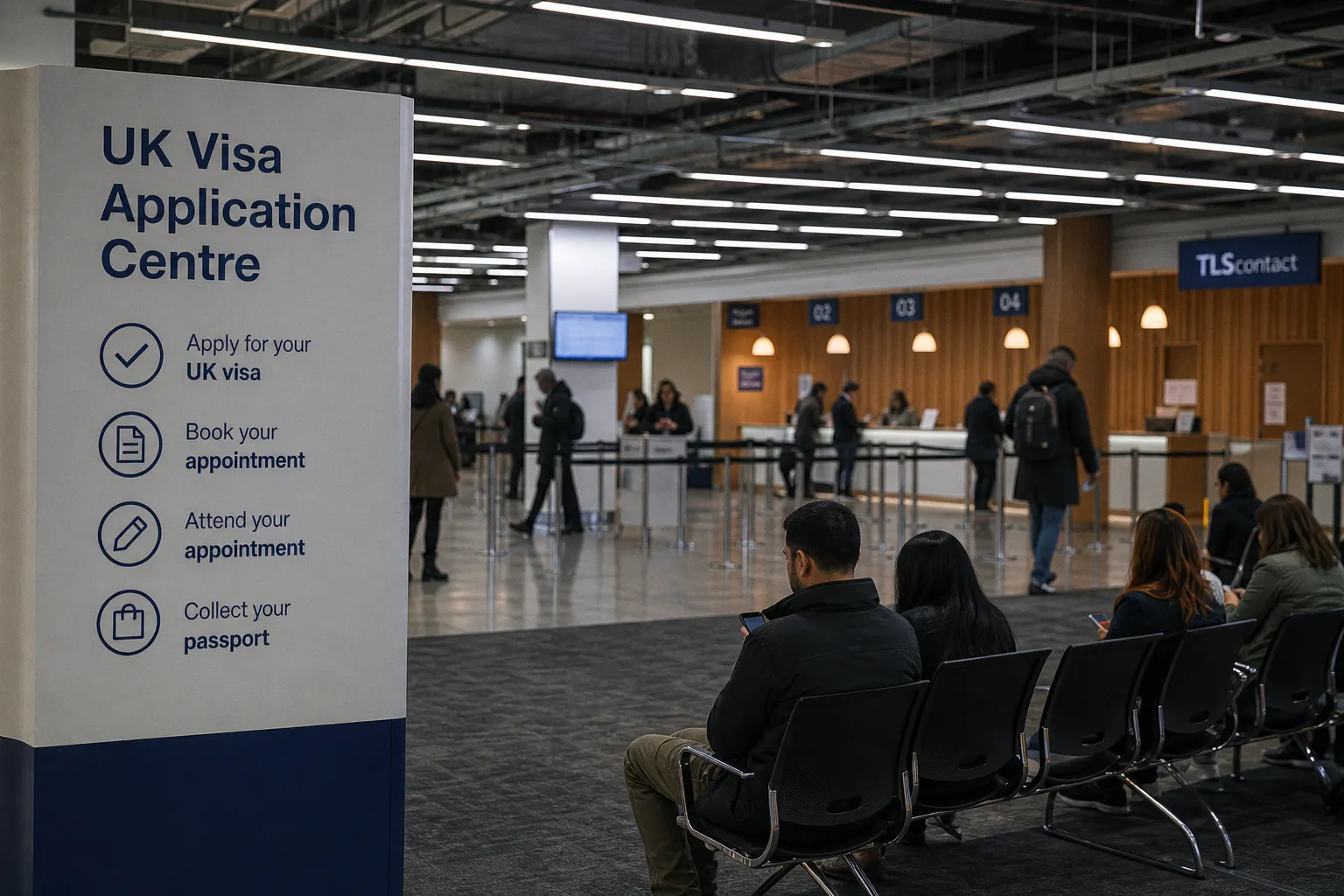
Once you've paid, you'll be redirected to a third-party booking system — usually TLScontact or VFS Global — to schedule a biometrics appointment at your local visa application centre. At the appointment you'll:
- Enrol fingerprints (all ten digits)
- Have a digital photograph taken
- Submit your passport and any physical documents requested
- Use a self-service kiosk or staffed counter, depending on the centre
Bring your passport, your CAS printout, a printed copy of your online application, and your financial evidence in the form requested (bank statements are usually uploaded online, but some centres still ask for paper originals). Don't laminate any documents. Don't use staplers, paperclips, or plastic sleeves inside your document folder — UKVCAS staff will remove them, and it slows the queue for everyone.
The appointment itself is short. Most centres process a student application in under 30 minutes if your file is in order. You'll be given a reference number to track your application online, and your passport will be returned by courier — or, in some locations, in-person collection.
What happens after you click submit
Standard processing from outside the UK currently takes around three weeks, though it stretches longer during peak intake windows. June through September is the busiest period. You can pay extra for priority or super-priority services in some regions, but availability depends on the local application centre and isn't guaranteed.
If your application is successful, you'll receive an eVisa — a digital record of your immigration permission, linked to your UKVI account. There is no longer a physical visa vignette sticker in your passport for most routes. You'll use the eVisa to prove your right to study, work part-time (subject to the usual weekly hour limits), and re-enter the UK during your course.
If something goes wrong — a missing document, a maintenance shortfall, an inconsistency on the CAS — you'll usually receive an email asking you to upload the missing item within a defined window. Respond quickly, and respond exactly as asked. Refusals for "failure to provide requested evidence" are entirely preventable.
The practical tip that saves the most stress
Here's the airport-queue equivalent for your visa application: the moment your university issues your CAS, open the GOV.UK portal that same week and complete the form in a single sitting. Save nothing for "later this weekend." The portal has a session timeout, partial saves sometimes don't persist, and re-entering a half-completed application is a known source of typos in critical fields like passport number and dates of birth.
If you want a mental model for due diligence here, think of how you'd treat any digital purchase that requires upfront commitment: the same instinct that makes buyers check sample clearances before committing to a digital album applies to a £2,818 visa submission. Read every screen. Confirm every figure. Verify your CAS details against your passport before you upload. The application is reversible until you click "submit" — and after that, every correction requires a paid change-of-circumstance request.
One last thing. If your application is refused, you have a right of administrative review (for caseworking errors) or the option to reapply with corrected evidence. A refusal isn't the end of your UK study plans; it's a triage moment. Read the refusal letter line by line, identify which rule you failed, address it precisely, and reapply. Thousands of students reapply successfully each year.
The system is dense, but it isn't adversarial. The Home Office isn't trying to trick you — it's trying to verify that you are who you say you are, that you've been accepted by a legitimate sponsor, that you can support yourself, and that you speak the language well enough to study. Meet those four tests cleanly, and the visa is yours.