Apply for a transit visa uk to change London airports
- Switching airports in London is not a connecting flight.
- It is a border crossing.
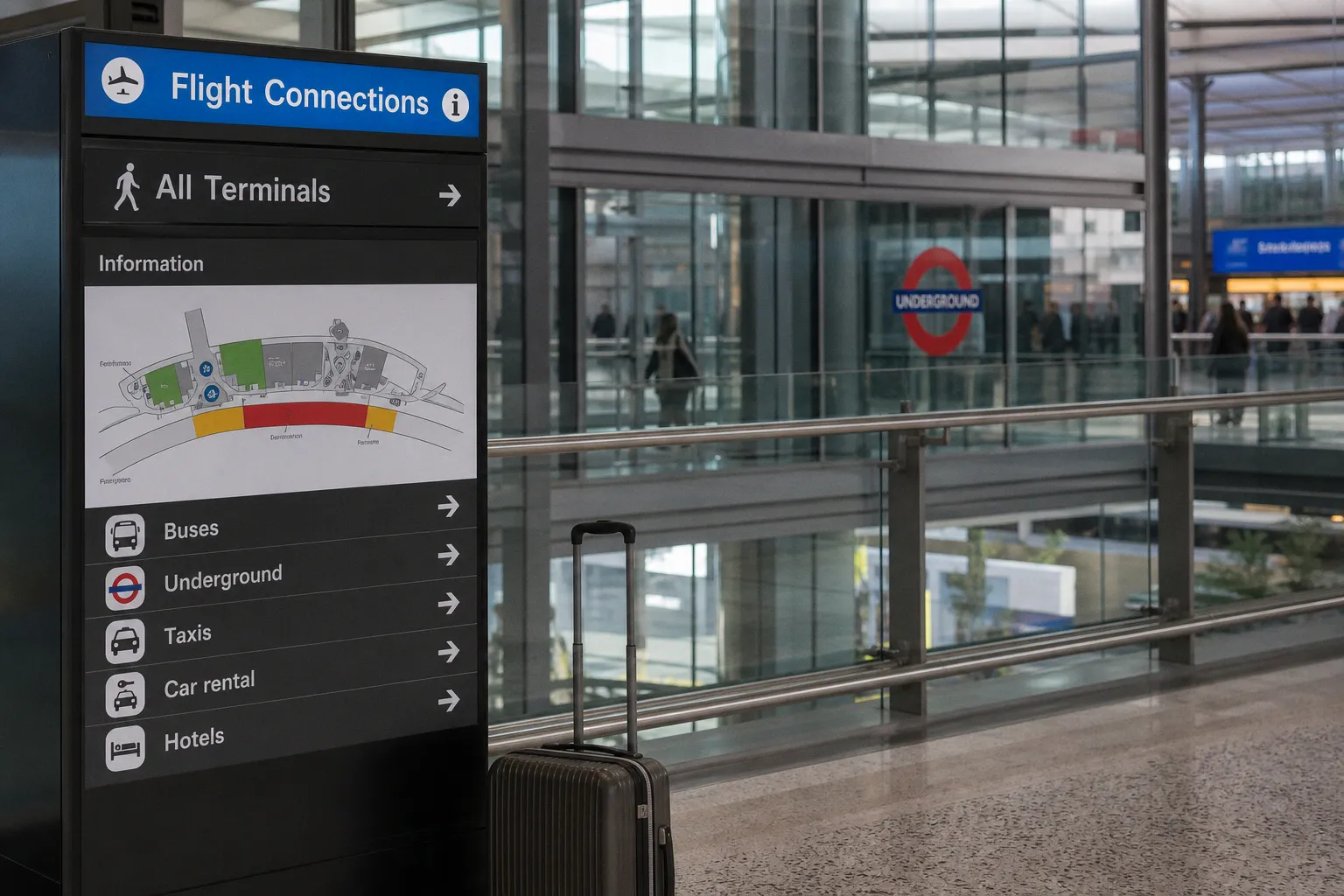
The Heathrow-to-Gatwick Problem Most Travelers Underestimate
UK border policy distinguishes sharply between airside transit — staying within the secure zone of a single airport — and landside transit, which requires passing through immigration to reach a different terminal or a different airport altogether. The £64 standard transit visa exists almost entirely for the latter category. The £64 fee buys 48 hours, and nothing more.
A transit visa is a permission to pass through, not a permission to stay. Confusing the two is the fastest route to a refusal at the border.
Who Actually Needs a Transit Visa to Change London Airports
The default rule is blunt. If a traveler holds a passport from a country on the UK's visa national list, they need a transit visa before boarding a flight to the UK — regardless of whether they intend to leave the airport. The only exceptions are nationality-specific visa waivers, diplomatic passports, and a narrow set of operational exemptions that rarely apply to commercial leisure travelers.
The most common scenario triggering this requirement: a non-visa-exempt national arrives at one London airport with a connecting itinerary departing from a different London airport. The same logic applies for transit between a London airport and a UK regional airport, or between Heathrow and Stansted, Gatwick and Luton, and so on. The geography of Britain compresses the problem — London has six commercial airports and no unified terminal.
Two transit visa categories exist:
| Category | Purpose | Maximum Stay | Fee (2026) |
|---|---|---|---|
| Direct Airside Transit Visa (DATV) | Transit within the same airport's secure zone without passing through UK border control | 24 hours | £64 |
| Visitor in Transit Visa | Landside transit, including changing airports, collecting/rechecking baggage | 48 hours | £64 |
Changing airports falls under the Visitor in Transit category. The DATV does not cover it. Travelers who book a DATV for a Heathrow-to-Gatwick itinerary will be turned back at check-in or refused boarding.
The Transit Without Visa (TWOV) Concession: Narrow But Real
The Home Office operates a long-standing concession under which certain travelers can transit landside without obtaining a visa. The mechanism is well-defined and unforgiving in its criteria.
A traveler qualifies for TWOV if all of the following are true:
- They are a national of a country listed in the TWOV eligible nationalities schedule.
- They hold a valid entry visa or permanent residence for one of: Australia, Canada, New Zealand, or the United States.
- They are traveling to or from that country on a reasonable onward itinerary.
- They have a confirmed onward flight departing within 24 hours of arrival.
- They remain landside only as long as operationally required.
The TWOV concession does not run on visa type interpretation. A valid B1/B2 for the United States counts; an expired ESTA does not. A permanent resident card for Canada counts; a Canadian visitor visa counts only if it remains valid on the day of transit. Travelers who assume equivalence between electronic authorizations and full visas discover the distinction at the boarding gate.
The £64 fee is flat. The eligibility rules are not. A US visa waiver holder (ESTA) does not satisfy the TWOV criteria, even though the ESTA looks like a visa in a passport.
The eligibility matrix below clarifies the most frequent cases:
| Traveler Profile | TWOV Eligible? | Transit Visa Required? |
|---|---|---|
| Indian national with valid US visitor visa, transiting London en route to New York | Yes | No |
| Indian national with valid ESTA only, same route | No | Yes (Visitor in Transit) |
| Pakistani national with valid Canadian permanent residence, transiting to Toronto | Yes | No |
| Nigerian national with valid US visa, transiting onward to the US | No (Nigeria is not on the TWOV nationality list) | Yes |
| Brazilian national with no US/CA/AU/NZ visa, transiting London to Dublin | No | Yes |
The nationality restriction is the most common failure point. The visa-majority countries — India, Pakistan, Nigeria, China, Turkey, Egypt — are largely excluded from TWOV entirely, regardless of what third-country documentation the traveler holds.
Applying for the £64 Standard Transit Visa: Process and Pace
The application pathway for a Visitor in Transit visa runs entirely online via the UK Visas and Immigration portal. There is no paper route. The Home Office has migrated the workflow to a structured digital form followed by a biometrics appointment at a Visa Application Centre (VAC), typically operated by either VFS Global or TLScontact depending on jurisdiction.
Application lead time operates on a single hard rule: applications open three months before the date of travel. Booking biometrics in any earlier window produces a system rejection. The practical advice is to begin the application no earlier than 90 days before departure and no later than the point at which a confirmed onward ticket exists — the system requires an onward travel booking to complete the file.
The fee structure for a 2026 application:
| Component | Cost | Notes |
|---|---|---|
| Standard visitor in transit visa fee | £64 | Non-refundable |
| Biometrics service charge | Variable by VAC | Set by VFS Global or TLScontact, not the Home Office |
| Priority processing (optional) | Additional fee at select locations | Not universally available |
| Courier return of passport | Variable | Optional at most centers |
Total out-of-pocket cost typically lands between £85 and £130 once VAC charges are included. Travelers who budget £64 and arrive unprepared for the service add-ons encounter queue-day friction.
One practical observation: the Home Office does not publish processing time guarantees for transit visas with the same specificity it applies to standard visitor visas. The published working-day estimates sit in a wide band, and priority slots depend entirely on the diplomatic post's daily allocation. Travelers whose onward itinerary has zero buffer should not assume a same-week turnaround.
The 48-Hour Permission Window: What the Visa Actually Allows
The Visitor in Transit visa permits entry to the UK for up to 48 hours, measured from the moment of arrival. The visa is not a tourism document. It does not authorize shopping trips to Oxford Street, museum visits, or overnight stays in a hotel unless those activities are operationally necessary to complete the transit.
Border Force officers retain full discretion to refuse entry, even when a traveler presents a valid transit visa with a confirmed onward ticket. The grounds for refusal most often cited at primary processing include:
- Insufficient evidence of onward travel (boarding pass vs. booking confirmation vs. ticket purchase — the hierarchy matters).
- Misrepresentation of transit purpose (treating the visa as a tourist entry).
- Inadequate funds for the duration of the transit (a soft criterion, but routinely applied).
- Damaged or inconsistent passport documentation.
Travelers whose onward flight is delayed beyond 48 hours face a specific problem. The visa does not extend automatically. Remaining in the UK past the 48-hour threshold without a valid basis constitutes overstay, regardless of the cause. The Home Office treats airline disruption as the carrier's commercial risk, not the traveler's immigration problem.
The clock does not pause for weather, strikes, or technical faults. A 48-hour visa means 48 hours.
Common Pitfalls When Transiting Between London Terminals
Five failure points recur with enough frequency to warrant specific mention.
1. Confusing the airport transfer with a connecting flight. Airlines selling multi-airport itineraries within London often treat the routing as a standard connection. The Home Office does not. The passenger remains responsible for securing transit authorization regardless of how the ticket was marketed.
2. Assuming the airline will catch a missing visa. Carriers face fines for transporting visa-national passengers without valid documentation. Most major carriers now run pre-flight eligibility checks. Some do not. The traveler should not outsource this verification.
3. Missing the three-month application window. Booking a transit visa more than 90 days before travel triggers an automatic refusal of the online application. Booking it too late — within 48 hours of departure — exposes the traveler to processing delays that may push arrival past the onward flight date.
4. Choosing the DATV by accident. The Direct Airside Transit Visa is for travelers staying within a single airport's secure zone. Selecting it for a Heathrow-to-Gatwick itinerary produces a visa that does not match the actual journey. Reapplication becomes necessary.
5. Ignoring the TWOV nationality list. A traveler who technically holds the right third-country visa but whose nationality is excluded from the TWOV schedule still needs the £64 visa. The concession is narrower than its name suggests.
Compliance Actions Before You Board
The process for a traveler confirming a Heathrow-to-Gatwick or similar inter-airport transfer lands on a fixed sequence of checks.
- Confirm nationality is on the visa national list and the appropriate transit visa category applies.
- Verify TWOV eligibility against the nationality schedule and the third-country visa criteria — both must be satisfied.
- Initiate the online application no earlier than three months before travel and only after a confirmed onward ticket exists.
- Budget £85–£130 inclusive of VAC service charges, not just the £64 headline fee.
- Carry proof of onward travel, sufficient funds, and biometrics confirmation at the port of entry.
- Monitor the 48-hour clock from the moment of arrival and treat any disruption as the carrier's commercial risk, not an extension trigger.
The UK government's transit regime is technically precise and procedurally unforgiving. Travelers who treat the £64 fee as the only variable tend to discover the additional costs at the worst possible moment — usually at the boarding gate or the primary inspection desk. The rule set is published, consistent, and entirely within the traveler's control to apply. The Home Office does not negotiate the criteria at the border.