Apply for UK Registered Traveller to use airport e-gates
- The UK Registered Traveller Service is closed.
- Not under review.
- Closed to new applicants and existing members since January 2023.
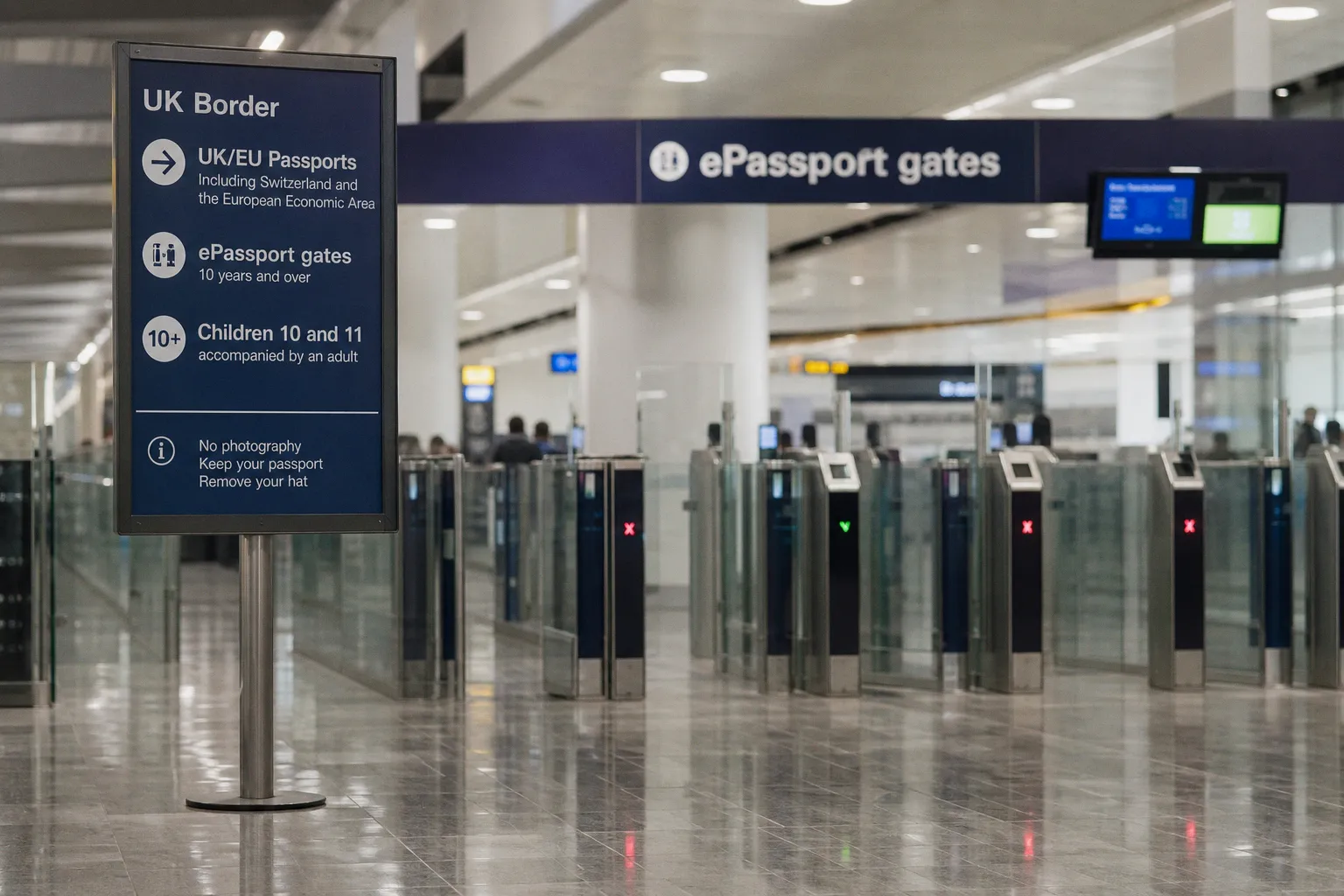
That matters because the old question — “how to check apply for UK Registered Traveller to use airport e-gates” — now has a different answer. There is no application route to check. There is no membership renewal to complete. There is no paid status that moves a traveller into a faster UK Border Force lane. The operational test is now simpler, and less negotiable: passport nationality, passport type, age, and whether the e-gate can read and match the traveller on the day.
The permanent closure of the Registered Traveller Service
The Registered Traveller Service was designed for frequent visitors who wanted a smoother arrival process at the UK border. Approved members could use e-gates at participating airports and, in some cases, faster lanes at passport control.
That system ended in January 2023.
The closure applies to:
- new applicants;
- existing members;
- renewals;
- travellers who previously held approval;
- travellers who had used the service successfully before closure.
The practical consequence is blunt. A traveller cannot apply for UK Registered Traveller to use airport e-gates. Any page, adviser, forum answer, or travel checklist suggesting otherwise is out of date.
This is not a minor administrative change. It removes a membership layer from UK port control. Border access is now determined by the general e-gate rules rather than by a pre-approved traveller scheme.
The Registered Traveller question is no longer an application question. It is an eligibility question at the border.
There is also no confirmed replacement fast-track programme for Registered Traveller. That point matters. The UK border system is moving toward wider digital pre-travel screening through Electronic Travel Authorisation, not toward a reinstated paid frequent-traveller lane.
The distinction is material. Registered Traveller was about arrival processing. ETA is about permission to travel to the UK before arrival. One does not simply replace the other.
Current e-gate eligibility is based on passport nationality and type
UK e-gate access now depends principally on the passport presented at the border. Not travel history. Not airline status. Not hotel booking value. Not a previous Registered Traveller account.
Eligible passport holders include, among others, travellers using passports from:
- the United Kingdom;
- EU countries;
- EEA countries;
- Switzerland;
- the United States;
- Canada;
- Australia;
- New Zealand;
- Japan;
- Singapore;
- South Korea.
The passport must be capable of being read by the biometric gate. In practice, that means an eligible biometric passport. If the document cannot be read, or if the automated facial match fails, the traveller is routed to a Border Force officer.
That is not necessarily a refusal. It is a manual inspection.
The e-gate decision is procedural. The gate checks the document and the traveller. Border Force systems then determine whether the traveller can be processed automatically or must see an officer.
A visa, entry clearance, frequent travel pattern, or historic membership does not by itself guarantee e-gate access. Nor does eligibility on paper guarantee that the gate will open. The system can fail closed.
A compact comparison is useful because many travel pages still blur the old and new models.
| Issue | Registered Traveller model before closure | Current e-gate model |
|---|---|---|
| Application route | Membership application and approval | No Registered Traveller application |
| Status since January 2023 | Closed to new and existing users | General e-gate rules continue |
| Main basis for access | Approved membership plus document checks | Passport nationality, passport type, age, and system processing |
| Payment | Service-based membership fee under the former scheme | No Registered Traveller fee because the scheme is closed |
| Operational decision | Membership could enable faster processing | Border system decides at the gate or sends traveller to an officer |
| Replacement programme | None confirmed | ETA rollout is separate pre-travel authorisation |
This is the core correction for anyone searching “how to check apply for UK Registered Traveller to use airport UK”. The current answer is not a hidden form. It is a border eligibility check.
The passenger should ask three questions before travel:
1. Is my passport from a nationality currently permitted to use UK e-gates?
2. Is the traveller old enough to use the gate under the UK age rules?
3. Do I still need separate permission to travel or enter, such as a visa or ETA, before reaching the border?
Those questions are operationally relevant. A Registered Traveller application is not.
Age rules: the gate is not available to every eligible passport holder
The minimum age for UK e-gate use is 10.
Children aged 10 and 11 must be accompanied by an adult. That requirement is not cosmetic. It changes how families should approach passport control. A 10-year-old with an eligible passport is not treated like an adult business traveller simply because the document is from an eligible country.
For families, the friction usually appears at the lane decision point. One adult may be eligible. One child may be too young. Another child may be 10 or 11 and require adult accompaniment. A group can be split or redirected.
The sensible operating assumption is this:
- children under 10 should not be planned around e-gate use;
- children aged 10 or 11 need an accompanying adult;
- older children may use e-gates if their passport and nationality qualify;
- any child may still be referred to a Border Force officer if the automated checks do not complete.
The family travel mistake is to read “US passport holders can use e-gates” or “EU passport holders can use e-gates” and treat that as a complete answer. It is not. Age sits alongside nationality.
There is also a practical point at the physical border. Families should not attempt to force a group through an automated lane if one member clearly falls outside the rules. That creates delay, not acceleration. Border Force staff will redirect the party. The queue advantage disappears.
ETA changes the pre-travel layer, not the e-gate rule
The UK is moving through the implementation phase of its Electronic Travel Authorisation system. The stated direction is clear: visitors who do not currently need a visa for short stays will eventually need ETA permission before travelling to the UK.
The rollout is phased through 2024 and 2025, with full implementation expected by the end of 2025.
This is where confusion enters the system. Many travellers will experience ETA as “the new thing I must do before using the UK border.” That is partly correct and partly misleading.
ETA is not Registered Traveller.
ETA does not mean a traveller has joined a trusted traveller lane. It does not create a paid fast-track status. It does not override the normal e-gate rules. It is a pre-travel authorisation requirement for non-visa nationals, implemented through a separate policy mechanism.
In system terms:
- Registered Traveller was an arrival facilitation scheme.
- ETA is a pre-travel permission screen.
- E-gates are an automated border control channel.
- Passport control remains the legal entry point.
- Border Force retains the ability to refer a traveller for manual examination.
Those are distinct layers. Government communications often compress them because they all sit under “border modernisation”. For passengers, compression creates bad decisions.
A traveller may have an ETA and still be unable to use an e-gate because of age, passport type, nationality, system routing, or an operational issue at the gate. Conversely, an e-gate-eligible traveller may still need an ETA before boarding once the requirement applies to that nationality.
ETA is not a fast-track product. It is a permission-to-travel control.
The financial implication is different as well. Under the old Registered Traveller model, the traveller paid for a membership service intended to reduce border friction. Under ETA, the fee schedule attaches to travel authorisation for affected non-visa nationals. That is a broader compliance cost, not a premium airport convenience product.
The precise processing times for all nationalities across the full ETA rollout should not be treated as settled across the board. The implementation is staged. Travellers should check the live requirement for their nationality before booking travel, and again before departure. In this area, stale information has a short half-life.
For readers tracking how policy claims are tested against official statements, independent fact-checking resources such as news verification and myth-busting explainers are useful when travel rumours start circulating faster than statutory instruments.
What happens at the airport now
At a UK airport or port, the passenger decision tree is narrower than the old Registered Traveller model.
A traveller arriving at passport control will generally face one of three outcomes:
1. Use the e-gate successfully.
The document is eligible, the traveller meets the age rule, the gate reads the passport, biometric checks complete, and no manual referral is triggered.
2. Attempt the e-gate and be referred to an officer.
This may happen because the document is not read properly, the facial match fails, the traveller is ineligible, or the system requires manual handling. Referral is not automatically adverse. It is manual processing.
3. Go directly to a Border Force officer.
This applies where the traveller is not eligible for the e-gate channel, is travelling with someone who cannot use it, or is directed there by airport staff.
The old Registered Traveller status no longer changes this. A former member stands in the same system as any other traveller with the same passport, age, and travel permission profile.
There are two points legal professionals and corporate mobility teams should remove from templates.
First, do not tell clients to “apply for Registered Traveller” as a current option. That instruction is obsolete.
Second, do not describe e-gate use as an entitlement flowing from a visa or ETA. The border channel and the permission basis are not the same instrument.
A traveller can hold valid permission to come to the UK and still be processed manually. That is routine border control, not a contradiction.
Why the closure matters for frequent travellers
The closure has the greatest effect on travellers who previously sat outside the general e-gate nationality list but could access faster processing through membership.
Before closure, the service gave selected frequent visitors a route into a smoother arrival process. After closure, that route disappeared. The system now relies more heavily on nationality-based e-gate eligibility and the wider digital border architecture.
This has several operational consequences.
- Travel managers lose a predictable upgrade path.
A company cannot solve arrival friction for a frequent visitor by sending them through a Registered Traveller application. The route does not exist.
- Former members need to update internal guidance.
Historic approval has no current utility. It should not appear in traveller profiles as an active border facilitation status.
- Arrival time assumptions should be revised.
If a traveller no longer qualifies for an automated route, connection planning should allow for standard passport control queues.
- Nationality-based differences become more visible.
Two employees on the same itinerary may face different border channels because their passports fall under different e-gate rules.
- ETA will add a separate compliance step.
For affected non-visa nationals, the pre-departure requirement must be completed before travel. It should not be confused with arrival lane access.
The policy direction is centralisation and pre-screening. That does not always mean less friction at the physical border. It often means friction moves earlier in the journey.
This is a familiar feature of UK border control. The visible queue is only one part of the system. The more consequential decision may already have been made through carrier checks, permission-to-travel systems, and document validation before the passenger reaches the primary control point.
How to check your position before travel
The current check is practical. It should be done before booking if timing is tight, and again before departure if the traveller is affected by ETA rollout.
Do not look for a Registered Traveller application form. Check the live conditions that now matter.
1. Confirm whether the Registered Traveller instruction appears in your itinerary or company guidance.
If it does, remove it. The service has been closed since January 2023.
2. Check the passport nationality against current UK e-gate eligibility.
Eligible groups include UK, EU, EEA, Swiss, US, Canadian, Australian, New Zealand, Japanese, Singaporean, and South Korean passport holders, among others. The passport itself remains the key object at the gate.
3. Check the traveller’s age.
The minimum age is 10. Travellers aged 10 and 11 must be accompanied by an adult.
4. Check whether ETA applies to the traveller’s nationality and travel date.
The UK ETA rollout is phased across 2024 and 2025. By the end of 2025, the system is intended to cover visitors who do not currently require a visa for short stays.
5. Separate permission from processing channel.
A visa, ETA, or other permission may be necessary to travel or enter. It does not guarantee an e-gate route.
6. Plan for manual referral.
Even eligible travellers can be sent to an officer. That is built into the system.
7. Update saved passenger profiles.
Remove references to active Registered Traveller membership. Retain only current passport, permission, and ETA-relevant data.
This is not a bureaucratic nicety. It affects missed connections, arrival staffing, client advice, and airline boarding confidence.
Immediate compliance actions
The Registered Traveller Service should be treated as a closed statutory and operational route. Any contrary instruction is legacy material.
For travellers and advisers, the immediate actions are strict:
- Do not apply for UK Registered Traveller. There is no active application route.
- Do not renew old membership. Existing membership status no longer operates.
- Check e-gate eligibility by passport nationality and passport type.
- Apply the age rule: 10 minimum; ages 10 and 11 with an adult.
- Check ETA requirements before travel as the rollout continues through 2025.
- Do not tell travellers that ETA or a visa guarantees e-gate use.
- Allow time for manual Border Force processing even where e-gate use appears likely.
The operative position is simple. UK Registered Traveller is finished. UK e-gate access is now a standard border control eligibility question, not a membership benefit.