Request a UK Visa Fee Waiver for Family Route Applications
A family visa application fee in the UK has climbed past £1,500 once the Immigration Health Surcharge is layered on top, and for households where every pound is already spoken for, that single number…
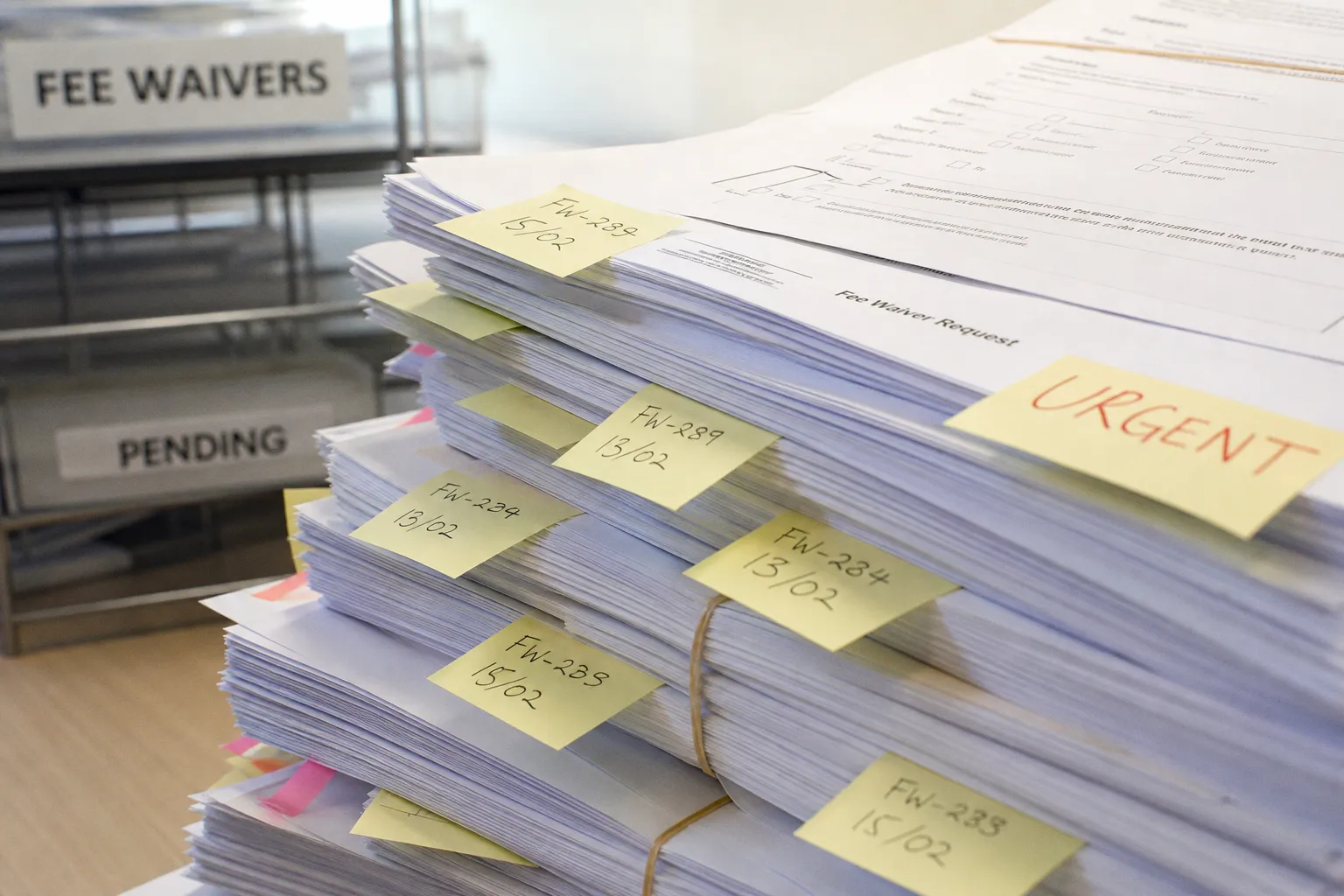
A family visa application fee in the UK has climbed past £1,500 once the Immigration Health Surcharge is layered on top, and for households where every pound is already spoken for, that single number can decide whether a partner or child stays legally in the country or slips into overstayer status while the money is scraped together. The Home Office's fee waiver route exists precisely for this squeeze, but the process is not a checkbox — it is an affordability test designed to be passed convincingly, not optimistically. If you are weighing whether to apply, the rule of thumb is simple: a waiver must be requested and granted before the main visa application is submitted, and it must arrive while you still hold valid leave. Get either of those out of sequence and the protective scaffolding disappears.
A fee waiver is not a discount, a refund, or a back-up plan. It is a pre-approved exemption from paying the application fee and the IHS — granted only after the Home Office agrees you genuinely cannot afford them.
The Affordability Test and Version 7.0 Caseworker Guidance
The legal standard behind every family-route fee waiver is the affordability test. In plain terms, a caseworker will work out what income and savings enter your household, subtract your essential living costs — rent or mortgage, utilities, council tax, food, transport, school-related expenses, any unavoidable debt — and ask whether anything remains. If the maths comes out zero, or worse, you are already drawing on credit to bridge a shortfall, a waiver can be granted. If the maths shows a surplus, even a modest one, you will be refused and pointed back to the standard payment route.
That assessment has been formalised in the Home Office's caseworker guidance, currently Version 7.0, which was published on 11 September 2024. Version 7.0 tightened the language around what counts as "essential" expenditure, refined how household composition is calculated when multiple adults contribute to one set of bills, and clarified the burden of proof on applicants who are in work but on reduced hours. It also reorganised the decision-making flow into clearer conditional steps, which is helpful if you are trying to anticipate the kind of questions your caseworker will ask.
Here is the practical translation: you are not arguing that life is expensive, you are demonstrating that life is unaffordable when measured against the specific line items the guidance expects. If you cannot show that on paper, no amount of supporting letters will substitute.
Securing Section 3C Protection During the 8-Month Backlog
Timing matters more than almost anything else in this process. Section 3C of the Immigration Act 1971 extends your existing leave automatically while a valid in-time application is being considered, which keeps you legal, eligible to work, and free from overstayer consequences while the Home Office deliberates. The catch is that this protection only attaches if your application is submitted before your current visa expires.
For fee waivers specifically, that means you must lodge your waiver request while you still hold leave. If your visa has already expired when you apply, there is no Section 3C backstop — and even if the waiver is eventually granted, the underlying leave would have lapsed in the meantime. This is why the earlier sources in your casework calendar tend to file the waiver request two to three months ahead of expiry, not a few days before.
The backdrop for that timing decision is brutal. As of the end of Q1 2024, the Home Office was sitting on 32,772 outstanding fee waiver applications, and reported processing times ranged from four to eight months during 2024–2025. During peak backlog periods, the approval rate for fee waiver requests dropped to around 1.5%, a figure that reflects how aggressively caseworkers applied the affordability threshold when staffing was stretched. Waiting months for an answer you cannot predict, while your visa clock keeps running, is the lived reality most applicants are navigating.
The practical implication is stark: if your leave expires in less than six months and you have not yet started a waiver request, you are already behind. Section 3C protection is the only thing standing between you and an unlawful status, and it only works if the application lands on the Home Office's desk before the expiry date stamps itself across your immigration record.
Evidence Thresholds: Six Months of Financial Transparency
A waiver request is judged almost entirely on documentation. The Home Office does not interview applicants; it does not take your word for the state of your finances; it reads the bank statements line by line and cross-references them against what you have declared. The standard evidence pack looks like this:
- Six months of bank statements for every account you hold, including joint accounts, savings accounts, and any current accounts that are nominally dormant but still open.
- Payslips covering the same six-month window, with the most recent payslip dated within 31 days of your application.
- Proof of all household expenditure — rent or mortgage statements, utility bills, council tax demands, child-related costs, travel-to-work costs, and any recurring debt repayments.
- Evidence of any income from other adults in the household if their money is pooled with yours, even if they are not themselves applying for a visa.
- Letters explaining any anomalies — a one-off inheritance, a redundancy payment, a debt that was written off, a bill that is paid in cash and therefore does not appear on a bank statement.
If your income is irregular, self-employed, or zero, the documentation bar rises. Self-employed applicants typically need to provide HMRC-acknowledged accounts or SA302 forms alongside the bank statements. If you are receiving Universal Credit or other state support, that is helpful context but it is not an automatic exemption — the affordability test still applies, and caseworkers have been known to refuse waivers for households in receipt of benefits if savings held above a minimal threshold make the test fail on paper.
The Home Office is not asking whether you are struggling. It is asking whether you have, or could reasonably be expected to have, the funds to pay. The difference matters.
One point that catches applicants off guard: the Home Office will look at spending patterns, not just income versus outgoings. Regular discretionary spending — subscriptions, dining out, non-essential shopping — will be weighed against your claim that you cannot afford the fee. If your statements show £200 a month going to streaming services and takeaways, a caseworker may reasonably conclude that you could redirect that money. This is not about policing lifestyle; it is about applying a test that expects you to demonstrate you have already stripped your budget to essentials before asking the state to cover the shortfall.
Managing the Unique Reference Number and the 10-Day Submission Window
Once a fee waiver is granted, you receive a Unique Reference Number (URN) by email, along with instructions for the next step. From that moment, the clock is short: you typically have 10 working days to submit your main visa application online, using the URN so the system recognises that the fee has already been waived. Miss the window and the URN expires; you would then need to apply for a fresh waiver, queue for another four-to-eight-month decision, and hope the timing still lines up with your leave.
This short fuse is one of the most common reasons applications collapse. The waiver arrives, the applicant is relieved, and they treat the next ten days as a grace period to gather their main application documents. In practice, the main application — biometric enrolment, evidence pack upload, sponsor documentation, relationship proof for family routes — needs to be substantially complete before the waiver decision lands. Any loose ends in the main file have to be resolved in those ten days or the whole thing unravels.
A useful habit is to treat the waiver request and the main application as parallel workstreams rather than sequential ones. Build the main application's evidence folder while the waiver is being assessed, so that the moment the URN arrives, you can submit the underlying application inside the working day, not at the eleventh hour. This is not a theoretical best practice — it is the single most reliable way to avoid wasting an approval that took months to obtain.
| Stage | Typical time window | Risk if missed |
|---|---|---|
| Waiver request submitted | 2–3 months before visa expiry | Loss of Section 3C protection |
| Waiver decision received | 4–8 months after submission | Nothing, if submitted in time |
| URN validity | 10 working days | Waiver expires; must reapply |
| Main application submitted | Within URN window | Full fee becomes payable |
The table above is not theoretical. These are the dates and windows that determine whether a granted waiver actually converts into a submitted visa application, or whether it expires unused because the applicant was not ready.
Partial Waivers and the Impact of Rising Immigration Health Surcharges
A common misconception is that a fee waiver is an all-or-nothing decision. It is not. The Home Office can grant a partial waiver if you can afford one element but not the other. So if your household can just about stretch to the application fee but cannot absorb the Immigration Health Surcharge, a partial waiver of the IHS alone is on the table, and vice versa. The caseworker will state explicitly what has been waived in the decision letter, and your main application will only ask you to pay the un-waived balance.
The IHS is the component most likely to break a household budget, and it has risen sharply. On 6 February 2024, the standard annual IHS cost climbed to £1,035 per adult, with a discounted rate for students and applicants under 18. Combined with the application fee itself — which went up by 20% on 4 October 2023 across family-route categories — the headline cost of a family visa application now sits well above what most lower-income households can absorb in a single month. A partial waiver request that targets the IHS specifically is therefore often the most realistic route, and the Version 7.0 guidance gives caseworkers more explicit permission to grant it than earlier versions did.
| Cost component | 2024 amount | Covered by waiver? |
|---|---|---|
| Family visa application fee (standard) | £1,321 (outside UK) / £1,048 (inside UK) | Yes, fully or partially |
| Immigration Health Surcharge (annual, adult) | £1,035 | Yes, fully or partially |
| IHS (annual, student / under 18) | £776 | Yes, fully or partially |
| Biometric enrolment fee | £19.20 | No |
| Premium service fees (optional) | Variable | No |
A partial grant still helps — it never leaves you worse off than paying the full amount — but it does mean the affordability arithmetic has to be done for each component separately, not as a single block. The practical upshot is that your evidence pack needs to demonstrate which specific cost you cannot meet, not just that you are broadly skint. Targeting the IHS and demonstrating that the application fee is manageable, or the reverse, is a more precise strategy than claiming you cannot afford either and hoping the caseworker agrees with the whole picture.
What the ICIBI Report Said and Why It Matters to You
On 20 March 2025, the Independent Chief Inspector of Borders and Immigration (ICIBI) published a report examining how the Home Office was handling fee waiver applications during the backlog period. While the report is framed as a critique of internal processes, several of its findings matter directly to applicants:
- Inconsistent decision-making between casework teams, particularly around what counts as "essential" living costs — the same household composition and spending pattern could be judged differently depending on which team processed the file.
- Poor communication when waiver requests are refused, with refusal letters that did not always explain which evidence was missing or insufficient, leaving applicants unable to correct gaps for a fresh submission.
- A lack of a published Service Level Agreement (SLA) for fee waiver processing, leaving applicants without a clear expectation of how long they should wait before escalating or seeking legal advice.
The ICIBI's recommendations included the introduction of an SLA — which the Home Office has indicated it intends to implement by the end of 2025 — and clearer refusal reasoning. As of writing, however, the SLA has not been confirmed in operational terms, so applicants should plan for the worst-case scenario of an eight-month wait and treat any earlier decision as a bonus, not an entitlement.
What this means in practice: if your waiver request has been pending for more than eight months with no decision, you have grounds to chase. But if it has only been three months, the Home Office is technically still within the window the report acknowledged, even though the wait feels interminable.
Practical Steps If You Are Starting This Process Now
If you are reading this and your visa expires in the next six months, the sequence is straightforward — but only if you treat it as a project with deadlines, not a form with fields to fill:
1. Work out your household's affordability position on paper before opening the online waiver form. If you cannot make the maths work in your own spreadsheet, a caseworker reading your bank statements will not make it work either. Be honest with yourself about what counts as essential versus discretionary.
2. Gather six months of statements, payslips, and household bills in a single folder so they are ready to upload. Do not rely on screenshots — most caseworkers require official PDFs from your bank's online portal. Request duplicates from your bank early; postal statements take time.
3. Submit the waiver request at least three months before your leave expires, accounting for the four-to-eight-month processing window. Earlier is always better than later. The Section 3C protection that keeps you legal depends entirely on this timing.
4. Prepare the main visa application in parallel — relationship evidence, sponsor documents, accommodation proof, English language evidence where required — so you can submit within ten working days of receiving the URN. Do not wait for the waiver to arrive before starting this work.
5. Keep copies of everything you submit, because if you are refused and reapply, you will need to show what changed, not what you have now. A second application that is identical to the first is a second refusal waiting to happen.
The fee waiver system is not designed to be friendly, but it is designed to be followed. Applicants who treat it as an evidence task rather than an emotional plea consistently come out better.
For the latest processing times, fee amounts, and guidance changes, always check the official GOV.UK fee waiver guidance and subscribe to the Home Office's operational updates. Immigration solicitors and recognised advisory bodies such as the Immigration Law Practitioners' Association (ILPA) also publish timely analysis when policy shifts occur — worth following if you want context beyond the raw guidance.
The Bottom Line
A UK family-route fee waiver is achievable, but it is not a sympathy award. It is a structured affordability test backed by six months of evidence, decided by a caseworker who will not see your face, and processed inside a backlog that has, at points, run to over 32,000 cases. The two failure modes are the same in nearly every refusal: evidence gaps and timing mistakes. Close both, and the process works. Leave either one open, and you are relying on a 1.5% approval-rate environment to be generous.
Treat the waiver as the start of a serious documentation exercise rather than a quick form. Build the evidence folder before you click submit. Keep your main visa application pre-loaded so the ten-day URN window does not catch you cold. And if your situation is genuinely unaffordable on paper, you are exactly who this route was built for — provided you can show it clearly enough for a stranger behind a desk to agree.