Duty free allowance from the UK to Ireland: key limits
The duty free allowance from the UK to Ireland turns on four hard numbers: 200 cigarettes, 1 litre of spirits, 16 litres of beer, and a €430 cap for other goods if you arrive by air or sea.
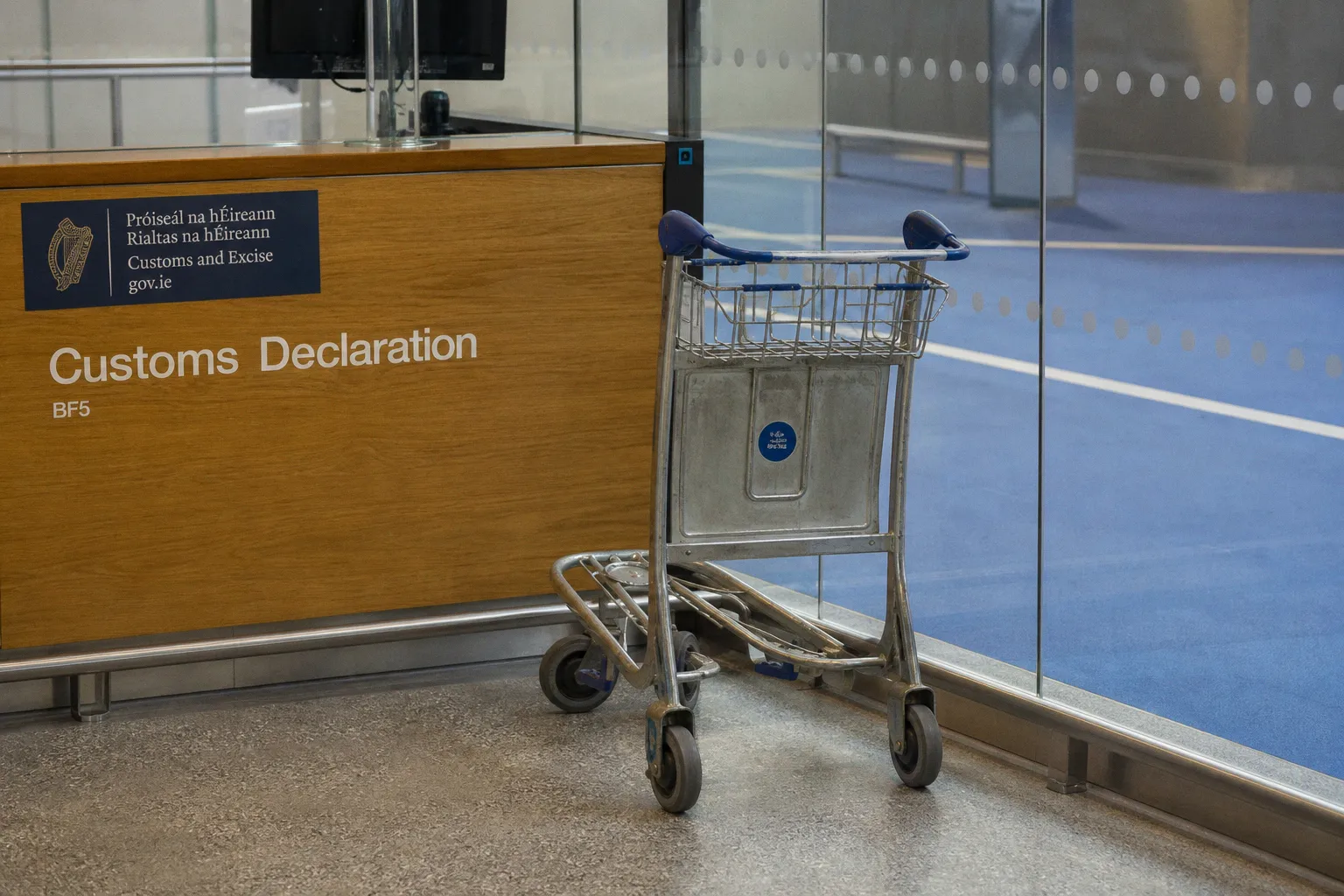
The duty free allowance from the UK to Ireland turns on four hard numbers: 200 cigarettes, 1 litre of spirits, 16 litres of beer, and a €430 cap for other goods if you arrive by air or sea. Miss those thresholds and you move out of “personal allowance” territory into a customs exposure problem.
That is the operational reality after Brexit. The Common Travel Area still protects the movement rights of British and Irish citizens. It does not turn goods in your luggage into EU goods. For customs purposes, the UK is outside the EU, and Ireland applies “rest of world” allowances to passengers arriving from Britain.
The post-Brexit rule: free movement of people is not free movement of goods
Here is the first point to lock down: the UK-to-Ireland journey is politically familiar, but customs treatment is not domestic. A passenger can move easily through the Common Travel Area and still be carrying goods that trigger Irish import rules.
That distinction catches people because the route feels informal. Flights from London, Manchester, Birmingham, Edinburgh or Glasgow into Dublin, Cork, Shannon or Knock do not feel like a hard external border. Ferries from Holyhead, Liverpool or Fishguard can feel even less formal. But the customs position is not based on how familiar the route feels. It is based on where the goods are coming from.
Since the UK is a non-EU country, goods brought into Ireland from the UK are assessed under Ireland’s non-EU passenger allowances. That includes alcohol, tobacco, perfume, electronics, clothing, gifts and other personal shopping.
Do not build your plan around the phrase “there are no customs checks.” That is a dangerous simplification. The Common Travel Area reduces immigration friction for eligible British and Irish citizens. It does not remove customs liability on goods.
Treat the UK-to-Ireland journey as a low-friction route for people, not a customs-free corridor for luggage.
For a traveller, the compliance strategy is simple: separate your position into two files.
- Your right to enter or move: usually governed by nationality, immigration status and the Common Travel Area framework.
- Your right to bring goods in without paying charges: governed by Irish customs allowances because the goods are entering from outside the EU.
- Your risk at the port or airport: driven by what you carry, whether it looks commercial, and whether you can explain the purchase and intended use.
That last point matters. Customs is not only a spreadsheet exercise. If you bring in quantities that look like resale stock, your argument that the goods are “for personal use” gets weaker fast, even if you are trying to stay close to the allowance.
Alcohol limits: the numbers are generous, but not flexible
For bringing alcohol from the UK to Ireland, the allowance is split by alcohol type. You cannot treat all alcohol as one pooled volume. A litre of whisky is not the same category as a litre of beer.
The standard passenger allowance is:
| Alcohol category | Allowance when arriving in Ireland from the UK |
|---|---|
| Spirits over 22% ABV | 1 litre |
| Fortified wine, sparkling wine or similar drinks | 2 litres |
| Still wine | 4 litres |
| Beer | 16 litres |
The key operational phrase is “or” in the high-strength category. You can bring 1 litre of spirits over 22% ABV or 2 litres of fortified or sparkling wine. You do not get both as a full separate entitlement in that slot.
Then you also have the allowances for still wine and beer: 4 litres of still wine and 16 litres of beer.
Put that into real baggage terms. One standard bottle of spirits is usually 700ml. Two bottles take you to 1.4 litres and put you over the 1-litre spirits allowance. A case of 24 cans of beer at 440ml each is 10.56 litres, inside the 16-litre beer threshold. Two such cases are 21.12 litres and over the allowance.
This is where travellers create their own refusal-grade file — not immigration refusal, but customs enforcement risk. They assume “duty free” means “whatever was sold in the airport shop.” It does not. The shop may sell it; Irish customs still applies the arrival limits.
Practical alcohol scenarios
Use the allowance like a project constraint, not a rough suggestion.
1. One bottle of whisky and a few bottles of wine
A 700ml bottle of whisky sits under the 1-litre spirits allowance. You still have room under the separate still wine allowance if you are carrying up to 4 litres of still wine.
2. Two bottles of gin
If both are 700ml and over 22% ABV, you are at 1.4 litres of spirits. That exceeds the 1-litre allowance. You should be ready to declare and pay any charges due.
3. A party load of beer
The beer threshold is 16 litres. That sounds large until you start counting cans. Four 4-packs of 500ml cans equal 8 litres. Eight 4-packs equal 16 litres. Beyond that, you are outside the allowance.
4. Sparkling wine plus spirits
This is where mistakes happen. The rule gives an allowance of 1 litre of spirits or 2 litres of fortified/sparkling wine in that part of the alcohol allowance. Do not assume you can max both categories.
The disciplined approach is to calculate before departure. Do not do it in the arrivals hall with a receipt in one hand and a customs officer waiting for a straight answer.
Tobacco limits: the allowance is clear, and mixing requires discipline
Ireland customs limits from the UK are especially strict on tobacco because the quantities are fixed and easy to test. The standard tobacco allowance is one of the following:
| Tobacco product | Allowance |
|---|---|
| Cigarettes | 200 |
| Cigarillos | 100 |
| Cigars | 50 |
| Smoking tobacco | 250g |
Again, the structure matters. These are not four separate full allowances to stack casually. If you bring a mix, the combined allowance is assessed proportionally.
For most passengers, the cigarette number is the one that matters: 200 cigarettes. That is usually one carton. Two cartons is not “a bit extra.” It is double the headline allowance.
Tobacco also creates a stronger suspicion profile than many other goods. A traveller carrying multiple cartons, especially across repeated trips, looks less like a normal passenger and more like someone moving controlled goods for financial gain. That is the risk you must mitigate.
Do not rely on the argument that the goods are cheaper in the UK. That explains why you bought them; it does not exempt them from Irish duty rules.
If your luggage looks like inventory, customs will not treat it like holiday shopping.
For tobacco, your defence file is simple: stay inside the allowance, keep the purchase ordinary, and avoid patterns that make the load look commercial. If you exceed the limit, declare. Hoping the route is too familiar to be checked is not a compliance strategy.
The €430 value cap: where electronics, perfume and gifts become the problem
Alcohol and tobacco get the attention because the numbers are memorable. But the €430 value allowance for other goods is often the more expensive trap.
For passengers arriving in Ireland by air or sea from the UK, the total value allowance for other goods is €430 per person. This category can include items such as perfume, electronics, clothing, accessories and gifts. If the total value of goods you are bringing in exceeds the allowance, customs charges may apply.
The strategic point: this is a value cap, not a suitcase-size cap. A single device can push you over it.
A new phone, camera lens, tablet, watch or high-end headphones bought in the UK can exceed €430 on its own. Perfume and cosmetics can also add up quickly, especially if you are carrying gifts for family. The fact that items are boxed, recently purchased and accompanied by receipts makes valuation easier, not harder.
Here is a basic way to pressure-test your position before you travel:
| Item type | Customs risk from UK to Ireland | Why it matters |
|---|---|---|
| New phone or tablet | High | One item can exceed the €430 allowance |
| Perfume and cosmetics | Medium to high | Multiple small purchases can quickly breach the cap |
| Clothing and shoes | Medium | Receipts, tags and packaging can show recent purchase |
| Gifts for relatives | Medium | Still count toward allowance if brought in from the UK |
| Personal used items | Lower | But must genuinely look and function as personal effects |
This is where travellers get sloppy. They treat “personal goods” as a magic phrase. It is not. A newly purchased laptop in sealed packaging is not protected just because you plan to use it personally. Personal use can matter, but it does not erase the import allowance.
The family allowance mistake
The €430 figure is per person, but do not abuse that rule.
If four adults travel together, each may have their own allowance. That does not automatically allow one person to buy a single expensive item and spread its value across the group. Passenger allowances are generally personal. If one traveller owns and carries the item, plan on that traveller’s allowance being the relevant threshold.
This matters for families arriving by ferry with boot space full of UK shopping. Splitting bags across the car does not change who bought the goods or what they are. If you are challenged, you need a coherent explanation.
For a clean file:
- Keep receipts accessible, not buried under luggage.
- Know which items were bought in the UK and which were already owned.
- Remove ambiguity where possible by travelling with used personal devices out of retail packaging.
- Do not assume gifts are excluded because they are not for you.
- If the value exceeds the allowance, prepare to declare rather than improvise.
The objective is not to win an argument at the port. The objective is to avoid creating one.
Common Travel Area: what it solves, and what it does not
The Common Travel Area is frequently misunderstood because it is powerful in one domain and limited in another.
For British and Irish citizens, the CTA allows broad freedom to move between the UK and Ireland. It is a core part of the relationship between the two states. But it is not a customs union for passenger shopping. It does not convert UK-origin purchases into EU purchases. It does not cancel Irish import rules. It does not give you unlimited alcohol, tobacco or electronics allowances.
Think of the CTA as an immigration mobility framework. Customs is a separate control layer.
That separation is normal at borders. A person can be fully entitled to enter and still have goods seized, taxed or questioned. Border agencies do not treat those questions as identical. Your passport answers one question. Your luggage answers another.
For non-British and non-Irish travellers, the situation can be even more layered. Your immigration position may depend on visa status, permission to enter, residence rights or transit rules. But the goods allowance problem remains the same: goods arriving in Ireland from the UK are subject to the relevant Irish customs limits.
Do not merge the issues. It weakens your decision-making.
A strong traveller file asks three questions before departure:
1. Can I travel on this route under my immigration status or nationality?
This is your movement eligibility threshold. Resolve it before you reach the port.
2. Are my goods within Ireland’s UK-arrival customs allowances?
This is your duty exposure calculation. Use the numbers, not assumptions.
3. If questioned, can I prove value, quantity and personal use?
This is your evidence layer. Receipts, quantities and packaging all matter.
If the answer to the third question is weak, fix it before you travel. Customs problems usually become harder once you are standing at the control point.
Declaring goods: build the file before you reach Ireland
The exact on-the-ground experience can vary by airport or ferry port. Some passengers may see a visible customs channel. Others may pass through with little interaction. Enforcement frequency is not something you should treat as predictable.
That uncertainty cuts against the passenger, not in their favour. If you are over the allowance, your safest position is to declare the goods and pay what is due. If no officer is immediately visible, follow the available customs declaration instructions at the port or airport. Do not decide that the absence of a conversation equals clearance.
There are two bad strategies here.
The first is concealment: spreading cigarettes across bags, removing packaging to hide purchase evidence, understating value, or claiming goods were already owned when they were clearly bought during the trip. That turns a duty issue into a credibility issue.
The second is casual overage: assuming that “only a little over” will not matter. Customs thresholds exist because the line has to be drawn somewhere. If you cross it, you need a declaration strategy.
What to prepare if you exceed the allowance
If you know you are over the UK to Ireland duty free limits, travel like someone who expects the question.
- Receipts or proof of purchase: customs needs value. Do not force an officer to estimate because you arrived unprepared.
- A clear quantity count: know litres, units and grams. “A few bottles” is not an answer.
- Ownership clarity: be able to say who owns which goods, especially in a group.
- Purpose of import: personal use is not a shield, but a commercial-looking load is worse.
- Willingness to declare: cooperation mitigates risk; evasion increases it.
This is the same discipline I would apply to a sponsorship certificate or a visa evidence bundle: remove uncertainty before the decision-maker sees the file. Border control is not the place to discover that your story has gaps.
For frequent travellers, keep an even tighter standard. A single trip slightly over the allowance may be one problem. A pattern of repeated high-volume alcohol or tobacco movement is a different risk profile. Customs officers are trained to look beyond the isolated suitcase.
The clean way to calculate your allowance
Use this sequence. It prevents most avoidable mistakes.
1. Separate alcohol, tobacco and other goods
Do not lump everything into one mental basket. Alcohol has volume limits. Tobacco has unit or weight limits. Other goods have a euro value cap.
2. Calculate alcohol by category
Spirits over 22% ABV are subject to the 1-litre limit. Fortified or sparkling wine sits in the alternative 2-litre slot. Still wine and beer have their own limits.
3. Calculate tobacco by product type
The headline cigarette allowance is 200. If carrying cigarillos, cigars or smoking tobacco, use the specific thresholds and be careful with mixed quantities.
4. Add the value of other goods
Include electronics, perfume, clothing, gifts and similar purchases. For air and sea arrivals, use the €430 allowance as the key threshold.
5. Check whether the goods look commercial
Even if you focus on numbers, presentation matters. Multiple identical items, bulk packaging or repeated travel can change how your luggage is viewed.
6. Decide before departure whether you must declare
Do not wait until the arrivals hall to make a risk decision under pressure.
This is not overengineering. It is basic border-risk management.
Worked examples: where travellers go wrong
The fastest way to understand the duty free rules UK to Ireland is to test them against real passenger behaviour.
Example 1: the weekend flight with whisky and tech
A passenger flies from London to Dublin with one 700ml bottle of whisky and a newly purchased tablet worth more than €430.
The whisky is likely inside the spirits allowance because it is below 1 litre. The tablet is the issue. If it exceeds the €430 value allowance for other goods, the traveller should not assume it passes duty-free simply because it is for personal use.
The risk is not the bottle. It is the boxed device.
Example 2: the ferry passenger with beer for an event
A passenger drives from Wales to Ireland with 20 litres of beer.
The beer allowance is 16 litres. The passenger is over the limit. The fact that the beer is for a family event does not remove the threshold. Declare and deal with the charges rather than trying to frame it as ordinary luggage.
Example 3: the smoker carrying two cartons
A traveller arrives with 400 cigarettes.
The allowance is 200 cigarettes. Two cartons double the limit. This is not a marginal calculation. It is an obvious overage and should be treated as such.
Example 4: the gift run before Christmas
A family arrives by air with perfume, headphones, clothes and boxed toys bought in the UK. No single item feels dramatic, but the combined value for one adult is above €430.
This is the classic value-cap breach. Customs does not only care about luxury goods. Multiple moderate purchases can exceed the allowance just as easily as one expensive device.
Final position: use the allowance as a hard border, not a travel tip
The duty free allowance from the UK to Ireland is not complicated, but it is unforgiving if you apply the wrong framework. Brexit changed the customs logic. The Common Travel Area still matters for people, but Ireland can apply non-EU import allowances to goods arriving from the UK.
Your control numbers are clear: 200 cigarettes, 1 litre of spirits over 22% ABV or 2 litres of fortified/sparkling wine, 4 litres of still wine, 16 litres of beer, and €430 for other goods when arriving by air or sea.
Build your journey around those thresholds. Keep receipts. Count quantities. Declare when you exceed the allowance. The common grounds for trouble are predictable: confusing CTA travel rights with customs exemptions, stacking alcohol categories incorrectly, treating gifts as invisible, and hoping a quiet arrivals channel means the rules do not apply. That is not strategy. That is exposure.