Spain's customs rules for UK arrivals: duty free limits
Walking through passport control at Madrid, Malaga, or Palma after a flight from the UK now means crossing a border that treats you as a non-EU arrival.
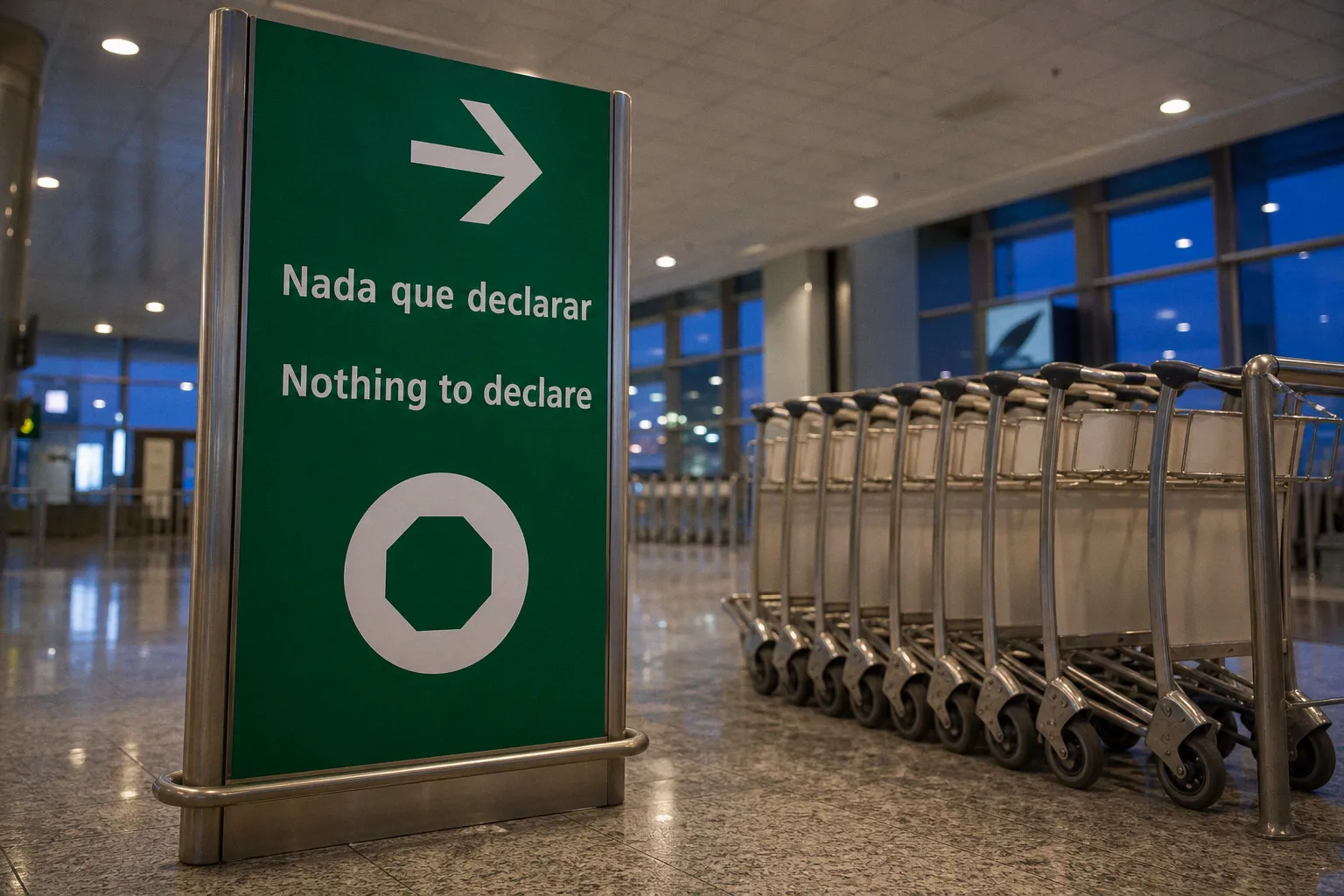
This piece walks through what those post-Brexit allowances actually are — alcohol, tobacco, "other goods" up to a defined value, and a cash declaration duty — and flags the rules where UK travellers most often get caught. The headline is encouraging. The limits are generous enough for ordinary luggage. The exception is meat and dairy, where there is no small-quantity fudge.
Your customs status at the Spanish border
Since the UK left the EU's customs union at the end of 2020, Spanish border officers have applied the EU's standard third-country allowances to British arrivals. There is no "former member" carve-out, no transitional exemption, and no honorary treatment because you used to breeze through with a half-case of Rioja.
What this means in practice is that your allowance now sits within a structured envelope: duty-free spirits, wine, beer, and tobacco up to specific volumes; "other goods" — gifts, perfume, electronics — capped at a defined value; and a hard prohibition on certain agricultural products. The framework isn't designed to be tricky. It's the same framework every non-EU arrival uses, and Spanish customs operate the same staffed booths for American and Australian passports as they do for yours.
If you've flown into Spain before 2021 and the duty-free shop at Heathrow now seems cheaper than the Spanish one, that's not your imagination. The "export" purchases you used to make were effectively intra-EU trade; the post-Brexit figures more closely match what someone flying into Madrid from New York would carry.
Alcohol and tobacco: the headline allowances
The principal allowances for non-EU travellers arriving by air or sea into Spain haven't dramatically changed since Brexit. They are explicit, and they interact in ways worth knowing before you pack.
Spirits: 1 litre of anything over 22% ABV. That covers whisky, gin, vodka, rum, tequila, and most liqueurs. A standard 700ml bottle is below the cap; a 1-litre bottle is right at it.
Wine: 4 litres of still wine plus 2 litres of either sparkling wine (Cava, Champagne, Prosecco) or fortified wine (sherry, port). The two categories stack, so a couple of bottles of Rioja, a Champagne for New Year, and a sherry for your host is comfortably inside the limits.
Beer: 16 litres, which works out to roughly 22 standard 700ml bottles, 32 standard 500ml cans, or 48 European-style 330ml cans. Realistically, no leisure traveller approaches this ceiling. It's there for the heavy cases.
Tobacco: 200 cigarettes, or 100 cigarillos, or 50 cigars, or 250g of loose tobacco — or, not and. You pick a category. Mixing is allowed at proportional limits (for example, half a cigar allowance plus half a loose tobacco allowance), and Spanish customs resolve these on a case-by-case basis.
A few practical pointers British travellers often miss:
- These allowances are per adult traveller, not per household.
- Combinations of products from different categories are allowed together — the limits apply within each category, not across all of them.
- Cigarettes rolled in your luggage from loose tobacco count toward the 250g loose tobacco ceiling, not a separate rolling-cigarette limit. Customs officers can and do weigh this.
- The allowances apply to anything you bring in, whether purchased at a duty-free shop, a UK supermarket, or gifted by relatives. The "duty-free" name refers to the tax-free entry, not where you bought it.
At a glance
| Category | Allowance | What it covers |
|---|---|---|
| Spirits (over 22% ABV) | 1 litre | Whisky, gin, vodka, rum, tequila |
| Still wine | 4 litres | Table wine, red, white, rosé |
| Sparkling or fortified wine | 2 litres | Cava, Champagne, sherry, port |
| Beer | 16 litres | ~22 bottles, 32 cans (500ml), or 48 small cans |
| Cigarettes | 200 | Or 100 cigarillos, or 50 cigars, or 250g tobacco |
| Other goods | €430 total | Gifts, perfume, electronics, souvenirs |
| Cash / bearer instruments | €10,000+ | Declared at the point of entry |
The meat and dairy prohibition — the rule that catches UK travellers
This is the line that catches more UK arrivals at Spanish customs than every other rule combined. Meat and milk — and any product containing them — cannot be brought into Spain as personal imports from the UK, and there is no small-quantity exception.
The European Commission's veterinary rules classify the UK as a non-EU third country for animal product movement, and the prohibition applies broadly:
- Cooked and cured meats: ham, salami, chorizo, Parma-style prosciutto, sausage rolls, pâté. None of it can come in.
- Dairy products: cheese of any kind — Stilton, Cheddar, Wensleydale, Brie. Milk, cream, butter, and yogurts are also covered.
- Items containing dairy ingredients: chocolate bars with milk solids (most British chocolate fits this), butter-based biscuits, condensed milk, and prepared products where dairy is part of the recipe. These sit in a grey area, but enforcement tends to err on restriction for any prepared product where dairy isn't the headline ingredient.
- Pet food and treats: treats and chews containing animal-derived ingredients are also caught, so don't pack a bag of British dog biscuits for your host's pet.
The meat and dairy ban has no small-quantity exception. If it's ham, cheese, sausage, pâté, or a milk-derived prepared product, leave it out of the suitcase.
Spanish customs enforce this rule with more seriousness than many UK travellers expect, particularly at airports where British tourism is concentrated. The entry-level outcome is confiscation. The medium-level outcome is a fine scaled to the volume. The escalation — commercial quantities, repeat offences — is prosecution under Spanish agricultural law.
The practical workaround is straightforward: leave it at home. Spain produces world-class cured meats, cheeses, and dairy that won't make you nostalgic for supermarket cheddar. If you're visiting family and want to bring a regional UK food gift, post it ahead of time rather than packing it.
"Other goods" and the €430 ceiling
Beyond alcohol and tobacco, everything else you're carrying for personal use counts toward a single cap: €430 total value for travellers arriving by air or sea, assessed per adult. Below that ceiling, the goods are duty-free and VAT-free under the personal import allowance. Above it, customs duty plus Spanish VAT (typically 21% standard, with reductions for some categories) applies on the excess.
What trips travellers up:
- The value is what the goods are worth, not what you paid. A duty officer assessing a €600 watch will not accept "I got it as a gift" as a value-reducer.
- Clothes in your suitcase and personal-use electronics (your phone, your laptop, your camera) don't count toward the cap — those are exempt as personal-use items.
- Gifts to other people are dutiable above the cap. A friend in Madrid wants a £400 pair of headphones you bought in the UK for them? That's within limits. Two such gifts? You're creeping above it.
- Children count separately in family groups, which roughly multiplies the threshold for a family of three or four. The customs form has fields for each traveller, and declarations are per person.
If you're carrying perfume, a couple of mid-priced gifts, and a few souvenirs, you'll clear easily. If you're shipping in a laptop, an expensive camera, or multiple premium gifts, keep proof of UK purchase and the items' values available in your hand luggage.
Cash declarations at €10,000 and the red flag of non-disclosure
This rule applies to every traveller entering or leaving the EU through any member-state border, including at a Spanish airport. Any cash, coins, or bearer-negotiable instruments (travellers' cheques, bonds, share certificates, gold coins) totalling €10,000 or more must be declared on the form presented at customs.
For most leisure travellers this is irrelevant. The friction shows up in three specific cases:
- Travellers on extended stays (retirees, remote workers, winter-sun residents) carrying large cash sums either by preference or because they're funding local life before their Spanish bank account is fully wired.
- People moving wealth out of the UK to a Spanish bank account, particularly property deposits where the transfer isn't going through a regulated channel in one step.
- Business travellers with company cash advances, settlement funds, or cash-heavy professions (auction buyers, antique dealers, certain craftspeople).
Declaration is straightforward. You fill out the form — either on the Spanish AENA app or on paper at the customs desk — hand it to the officer, and continue. The penalty for failing to declare isn't a fine for a low-five-figure forget-it-in-your-pocket situation; the cash can be temporarily seized, and Spanish enforcement treats non-declaration as a red flag for money laundering. Resources put against this have grown since Brexit, and uncertainty gets punished more than most rules on the page.
What actually happens at the Spanish border
The mental model many UK travellers carry is that the green channel is the "nothing to declare" lane and the red channel is for serious business. That's mostly right, but the green channel isn't a free pass — it's the lane where you walk through unchallenged, conditional on everything being below the limit.
If you've cleared the rules before you packed, you walk through the green channel, scan your passport at the staffed booth, and you're out. Border processing for UK nationals at Spanish airports is staffed-lane based, and wait times once you're at the front of the queue are typically measured in seconds at the booth itself.
If you're carrying items above the allowances or you're unsure, you use the red "something to declare" lane. Officers assess the duty, take payment by card, and you continue. This isn't a punishment; it's a routine transaction carried out in a couple of minutes in most cases.
If you've got meat or dairy in your bag, there's a dedicated agricultural control point before passport control at most Spanish airports, with bins for voluntary surrender. Don't test officers' goodwill by walking it through — x-ray and detector dog sweeps are routine on UK-origin flights, and the conversation that follows a flagged item is more formal than the surrender option.
Treat the green channel as a confident walk-through only if everything in your bag is below the headline allowances — and no item contains UK-origin meat or dairy.
The airport process is engineered for volume, not adversarial encounters. Spanish customs officers at major tourist airports see thousands of British travellers a week during peak season, and they know the post-Brexit allowances are recent for most of them. As long as you've addressed the meat and dairy question before you fly, the rest is a confident walk to the baggage hall.
A practical tip for the queue
Two small habits will save time at Spanish border control that have nothing to do with declarations. First, complete any required declarations on the Spanish AENA app — or the paper form at staffed booths — before you reach the front of the queue, with the value of any items you're carrying to declare pre-calculated. That shaves seconds off each traveller and noticeably off your party's total time. Second, keep receipts for any item over €100 in hand luggage, not checked baggage. If you're spot-checked on duty or value, retrieving proof from a suitcase in the baggage hall is the kind of hold-up you don't want at the start of a holiday.
The system isn't adversarial. It's a set of plainly stated envelopes — alcohol, tobacco, value, agricultural restrictions — and a declaration duty for significant cash sums. As long as your luggage respects the rules, the Spanish border process is one of the smoother arrivals in Europe for a UK traveller.