Cigarette limits from the UK to Ireland: post-Brexit rules
The duty free allowance from the UK to Ireland for cigarettes is 200 cigarettes per eligible traveller when the journey starts in Great Britain: England, Scotland or Wales.
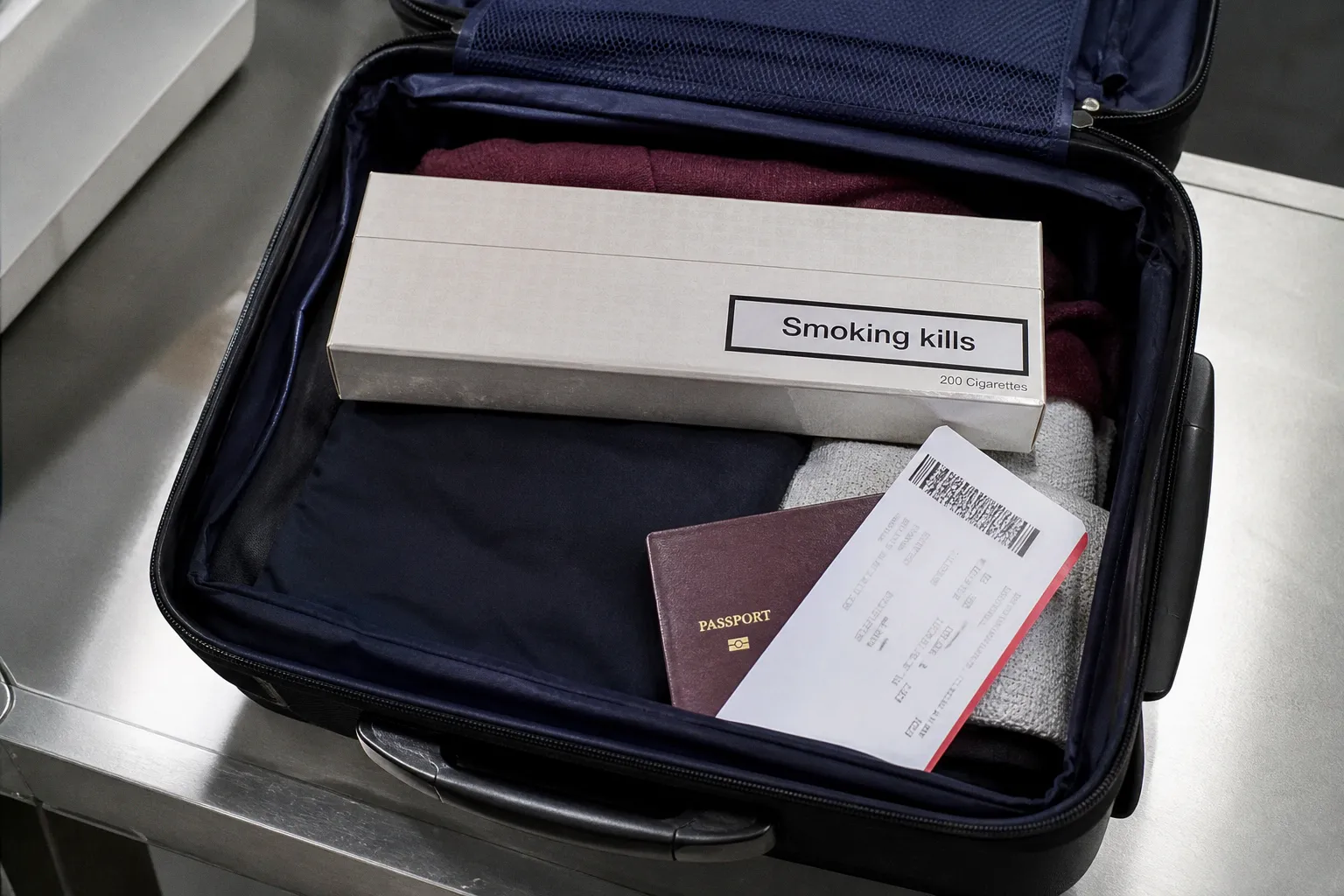
That is the post-Brexit position. Great Britain has been treated as a non-EU origin for Irish customs purposes since 1 January 2021. The familiar assumption that a UK–Ireland trip is a domestic-style crossing, or that an Irish Sea ferry route avoids customs rules, is wrong.
The distinction that decides the allowance is not the passport held by the traveller. It is the place from which they arrive.
From 9 December 2025, the enforcement position became materially stricter: where a traveller exceeds the permitted tobacco limit, Irish Revenue may seize the entire quantity, not merely the cigarettes above the allowance. For 2026 travel, the arithmetic is therefore simple. Do not treat the 200-cigarette figure as a tolerance threshold.
For arrivals from Great Britain, 200 cigarettes is the tax-free allowance — not a target, and not a partial exemption for a larger load.
Great Britain and Northern Ireland are not the same customs route
The phrase “travelling from the UK” is too broad for tobacco rules. Great Britain and Northern Ireland sit in different goods regimes.
A passenger travelling from Liverpool, Holyhead, Fishguard, Heathrow, Gatwick or any other Great Britain departure point into Ireland is arriving from outside the EU for these purposes. The non-EU duty-free allowance applies.
A passenger travelling from Northern Ireland to the Republic of Ireland is in a different category. Northern Ireland remains aligned with EU excise arrangements for goods. The relevant reference point is therefore the EU’s indicative personal-use limit, including 800 cigarettes.
That 800-cigarette figure needs careful handling. It is an EU indicative limit, not a retail entitlement and not a licence for commercial movement. Customs authorities can assess whether goods are genuinely for personal use. Quantity matters. So do the circumstances: repeated journeys, packaging, receipts, destination and any evidence that tobacco is intended for resale.
| Journey into Ireland | Tobacco framework | Cigarette figure |
|---|---|---|
| Great Britain to Ireland | Non-EU traveller allowance | 200 cigarettes |
| Northern Ireland to the Republic of Ireland | EU personal-use indicative level | 800 cigarettes |
| Any route where tobacco is for resale or commercial supply | Personal allowance does not apply | No personal-use protection |
This is the operational point travellers often miss. A ferry from Great Britain does not become a Northern Ireland journey because it crosses the Irish Sea. Departure location controls the treatment.
The same applies to route planning. A traveller who buys tobacco in Great Britain and then proceeds to Ireland should not assume that the product’s duty-paid status in the UK resolves Irish import obligations. It does not.
The standard Ireland duty-free tobacco allowance from Great Britain
For an eligible person arriving in Ireland from Great Britain, the tobacco allowance can be taken in one of several forms:
- 200 cigarettes
- 100 cigarillos
- 50 cigars
- 250 grams of smoking tobacco
The traveller must be at least 17 years old to use any tobacco or alcohol duty-free allowance. A person under 17 has no tobacco allowance. Carrying cigarettes for a child does not create an additional entitlement.
The allowance is per traveller. It is not a household allowance, a vehicle allowance or a bag allowance.
A couple travelling together may each qualify independently, subject to age and the other conditions. But travellers should keep their own tobacco clearly attributable to them. Customs decisions are made on the facts of the journey, not on improvised explanations at the point of inspection.
The rule also applies whether the tobacco was bought in a duty-free shop, a UK supermarket, a petrol station or online before travel. The relevant question at Irish entry is what is being imported, where the journey originated, and whether it falls within the traveller’s permitted allowance.
Tobacco must be for personal use or a genuine gift
Duty-free tobacco cannot be imported for onward sale. Nor can one traveller use another person’s allowance as a purchasing mechanism.
A gift may fall within the traveller’s allowance, provided it is genuinely a gift rather than a sale or commercial arrangement. That distinction becomes difficult to sustain where the quantity is high, journeys are frequent, or the traveller is carrying tobacco on behalf of multiple people.
There is no special exemption for frequent ferry passengers, cross-border workers, sports teams or family groups returning together from Great Britain. Individual facts may vary. The underlying allowance does not.
Mixed tobacco allowances can be split — within the same total entitlement
Irish rules permit a fractional split across tobacco categories. This is useful for travellers who do not want their entire allowance in one product type.
The limits are not cumulative. A traveller cannot bring 200 cigarettes and 50 cigars duty-free. Instead, they can divide one allowance proportionately.
For example:
1. 100 cigarettes and 25 cigars use the full allowance: each represents half of its relevant maximum.
2. 100 cigarettes and 50 cigarillos also use the full allowance.
3. 50 cigarettes and 125g of smoking tobacco use three quarters of the overall allowance: one quarter in cigarettes and one half in tobacco.
4. 200 cigarettes plus any additional tobacco product exceeds the tobacco allowance for a Great Britain arrival.
The calculation is based on fractions, not on a general “small extra item” principle. A few additional cigars can still push the traveller beyond the permitted total once the cigarette portion has already used the allowance.
Mixed allowances are permitted. Stacking full allowances is not.
This is one area where loose language at the airport or ferry terminal causes avoidable trouble. “I only have one carton and a few cigars” is not a customs category. The products are converted into proportions of the same tobacco allowance.
Why the December 2025 enforcement change matters in 2026
The practical risk changed on 9 December 2025. Under the stricter Irish Revenue approach, a traveller exceeding the permitted tobacco quantity may lose the entire tobacco consignment.
Previously, some travellers assumed the exposure was confined to the excess: bring 240 cigarettes, lose or pay duty on 40, retain 200. That is not a safe operating assumption under the current enforcement framework.
The consequence is disproportionately severe for travellers carrying multiple cartons. A modest overage is no longer necessarily a modest problem. The policy removes the incentive to gamble on an officer treating the first 200 cigarettes as automatically protected once the overall tobacco quantity is above the permitted level.
This is particularly relevant on Great Britain–Ireland ferry routes. Some passengers still view the crossing as low-friction because of the Common Travel Area. The Common Travel Area concerns movement rights for British and Irish citizens. It does not cancel customs controls, excise rules or baggage examination powers.
Passenger processing may appear routine. That does not mean goods are outside customs jurisdiction.
Irish Revenue can conduct checks at ports and airports. The exact selection rate for vehicle searches, baggage screening or passenger interventions is not published as a useful planning figure. It does not need to be. Compliance should be based on the declared rules, not on assumptions about the probability of inspection.
For travellers monitoring wider European travel rules before a multi-country trip, English-language reporting on France can help distinguish national entry developments from the separate Irish customs rules that apply at the point of arrival.
The Red Channel is the correct route for excess goods
A traveller arriving from Great Britain with cigarettes or other goods above the allowance must use the Red Channel and declare the goods.
This is not optional because the traveller intends to pay. The Red Channel is the mechanism for presenting taxable goods to Customs and paying the applicable charges: Customs Duty, Excise Duty and VAT where assessed.
There is a critical limitation. The tobacco allowance is a tax-free concession. It is not a guaranteed right to import any larger quantity by simply paying at the border. The stricter seizure policy means travellers should not assume that declaring an over-limit tobacco quantity will preserve all of it.
The correct sequence is:
1. Identify the journey origin before buying tobacco. Great Britain and Northern Ireland produce different results.
2. Calculate the total tobacco proportion if carrying more than one product type.
3. Separate tobacco from other travellers’ belongings so ownership is clear.
4. If goods exceed the allowance, proceed directly to the Red Channel.
5. Answer customs questions accurately and retain purchase evidence where relevant.
6. Do not conceal tobacco in luggage, a vehicle, packaging or another person’s belongings.
Concealment makes a straightforward duty issue into a more serious enforcement issue. It also weakens any claim that the traveller misunderstood the applicable allowance.
Other goods do not expand the tobacco allowance
The general allowance for other goods is separate from tobacco. An adult arriving in Ireland from a non-EU country may have a general allowance of €430 for goods such as gifts and souvenirs. For travellers under 15, the relevant figure is €215.
That does not mean €430 can be spent on extra cigarettes once the 200-cigarette limit has been used. Tobacco has its own specific allowance. It cannot be absorbed into the general goods threshold.
The distinction matters at airport duty-free stores. A traveller may be below the €430 value limit for all purchases while still exceeding the tobacco quantity limit. Quantity and product category control the tobacco calculation.
Alcohol operates in the same broad way: it has separate allowance rules and is also restricted to people aged 17 or over. A passenger cannot use an unused alcohol allowance to increase the permitted cigarette quantity.
Common errors at Irish ports and airports
The recurring mistakes are procedural, not technical. They arise from treating the route as simpler than it is.
Confusing nationality with origin. A British citizen arriving from Dublin after starting their journey in Belfast is not in the same position as a British citizen arriving directly from Holyhead. The customs route matters.
Using the Northern Ireland figure for a Great Britain journey. The 800-cigarette EU indicative level is not the Ireland duty-free tobacco limit from England, Scotland or Wales.
Treating 200 cigarettes as an amount Customs will ignore. It is the full tax-free limit. Adding even a small amount of another tobacco product can exceed the combined allowance.
Assuming a duty-free shop changes the rule. It changes the point of purchase, not the Irish import treatment.
Packing all tobacco in one person’s luggage. This creates an avoidable evidential problem. A personal allowance belongs to a person, not to a suitcase.
Relying on infrequent checks. Customs enforcement is not a lottery strategy. The potential loss under the 2026 seizure rules exceeds any small retail saving from carrying excess tobacco.
The practical position for 2026
For most travellers, the answer to “how many cigarettes can I bring from the UK to Ireland?” is 200 cigarettes, but only if “the UK” means Great Britain.
If the journey begins in Northern Ireland, the framework is different and the 800-cigarette EU indicative level is the relevant reference point. That does not eliminate the personal-use test. It changes the starting rule.
The post-Brexit duty free allowance from the UK to Ireland for cigarettes is therefore best understood as a route-specific customs rule, not a universal UK entitlement. Great Britain is non-EU for this purpose. Northern Ireland is not treated the same way for goods.
Before departure, take these immediate compliance actions:
- Confirm the actual departure territory: Great Britain or Northern Ireland.
- Cap Great Britain arrivals at 200 cigarettes unless using a properly calculated mixed tobacco allowance.
- Keep all tobacco within one combined allowance rather than adding separate full limits together.
- Do not rely on the €430 general goods allowance to cover additional cigarettes.
- Use the Red Channel for goods above an allowance and be prepared for duty, tax or enforcement action.
- Do not carry tobacco for resale, informal distribution or another traveller.
- Assume that excess tobacco can put the whole quantity at risk under the enforcement rules effective from 9 December 2025.
That is the compliance baseline. The old habit of treating Great Britain–Ireland travel as exempt from meaningful tobacco controls is now expensive.